
The Most Important Part Of The Training Cycle
Key Takeaway
Our last article went into the different phases of a training cycle that were discussed in the book I’ve been reading, Special Strength Development For All Sports, by Louie Simmons. On Chapter 6, page 89, Louie goes into the textbook training periods for an athlete: Accumulation, Intensification, Transformation, and then Delayed Transformation.
This article will focus on Accumulation. Accumulation is the phase of training where we do higher volume at (mostly) moderate intensity. A good program for a first responder will train strength, conditioning, and power.
You can ebb and flow between what you emphasize during different portions of this cycle, but overall this is where we are training our large base of fitness so we can recover from harder training in the future.
I’ll provide examples from the first 4 weeks of Enduring Phase I to give you an idea of how you can set this up and see what you can take advantage of during our live programming.
Example- Enduring Phase I
In our first phase of Enduring we took 8 weeks to set the foundation prior to moving our athletes to the second phase that we are currently running. Here is the first week of training:
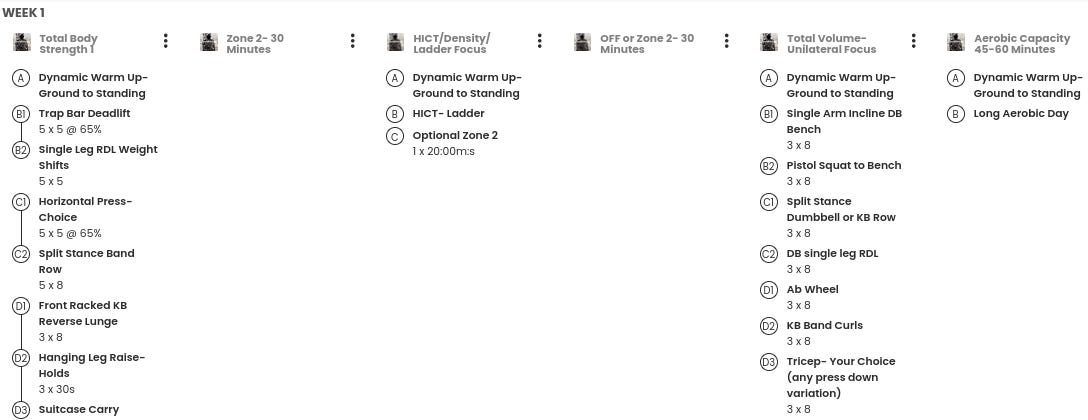
For Enduring Phase 1 we chose to go with two dedicated total body strength days. In the middle of the week we do a High Intensity Continuous Training Ladder Circuit that we slowly raise the volume on over 8 weeks. Here is the first 4 week progression and one Circuit example (we provide 5 options):
Overall Schedule:
Week 1: 2 x 8 Minutes (Rest about 5 minutes between sets)
Week 2: 1 x 15 Minutes
Week 3: 2 x 10 Minutes (Rest about 5 minutes between sets)
Week 4: Bodybuilding Deload (this week we don’t do this session)
5 Options- Stick with 1 or 2 for at least 3 Weeks just so you can measure your progression. Weeks 4-6 use another circuit.
Option 1:
A1) Sled Push- 10, 15, 20 yards
A2) Sled Pull- 10, 15, 20 yards
A3) Push Ups- 1, 2, 3
A4) Inverted Row or Pull Up- 1, 2, 3 Reps
(Only use pull ups if higher volume doesn’t bother your elbows/shoulder)
The way this should look:
Round 1: Push/Pull Sled 10 yards. Then do 1 Push up, 1 Inverted Row
Round 2: Push/Pull Sled 15 yards. Then do 2 Push up, 2 Inverted Row
Round 3: Push/Pull Sled 20 yards. Then do 3 Push up, 3 Inverted Row
Then repeat the whole thing, but start back at 10 yards, 1 Push Up, 1 Inverted Row. You’ll keep repeating this ladder for the duration listed. In week one you’ll keep moving for 8 minutes, then rest for 5, then go for 8 minutes again. You should ideally be moving the entire time.
Explanation
As you can see, the HICT volume builds via timed sets. As your fitness improves you will get in a ton of work during this session. People really seem to enjoy these as they are challenging, but at the same if you listen to the instructions and keep your heart rate right around 150-155bpm you’ll be training your aerobic system during these sessions while also getting a mild strength benefit. Moving under load while under fatigue is a skill you’ll need in these professions, and this is a really “easy” way to train this.
Bigger Gas Tank + Bigger Engine = Faster Recovery
You’ll get several benefits by dedicating a few weeks to this style of training. You’ll focus a bit on training density, or the amount of work you’ll get in during a given time period.
As you nudge up your ability to do this with the structure I listed above, you’ll be building yourself a bigger gas tank. This bigger gas tank, assuming it is gradually trained, will enhance your body’s overall ability to recover. We keep our heavier strength training days (it gets heavier you’re only looking at week 1) relatively far apart during the week to ensure you keep getting quality sessions in.
Another note I constantly try to remind people is that when you do something hard, like a max effort sprint, spar session, foot pursuit, officer involved shooting, or other critical incidents…when you’re done and trying to catch your breath and your body just had a cascade of stress hormones dumped on it…that is your aerobic system working to get you back to your baseline. If you train your aerobic system, the time it takes you to recover will decrease, and you’ll be able to perform again faster. Please reread that.
If you don’t take the time to work in these moderate intensities with higher volume and just jump to high intensity intervals, you’ll simply be training how to red line whatever you already have built for your energy system. You’ll just be learning how to demonstrate whatever fitness you already have…not building anything new. You’ll flatten out in about 3-4 weeks and then your progress will probably even backtrack.
Closing
If you missed Enduring Phase I, it is available now as a standalone purchase. If you’re in exceptional shape, you can probably just jump right into phase II that is currently live. Just be honest with yourself for where you’re currently at. This is a great time to get back into training and then meet us for our next phase in 2026 that is going to be awesome. Intense…but awesome. Questions? Comment below.