
Training design for long term progress.
Key Takeaway
I am clearly not good at AI prompts. I used words like tactical, first responder, firefighter, and SWAT thinking I would get multiple people in those professions doing exciting work. Instead, I got a mutant dystopian profession all rolled into one.
In spite of this, I realized if this profession existed, and I was going to train them, not much would change in our programming. With the exception of more extreme conditions like selections, rural SWAT officers covering longer distances (vs. urban), or smokejumpers…the day to day training structure of our FIRESWAT operator from the year 2060 wouldn’t be much different. The physical capacities would be very similar, and would follow a progression much like we use in our training programs.
Training Phases- For Athletes
I have been reading through an excellent book, written by the late great Louie Simmons, Special Strength Development For All Sports. In the beginning of Chapter 6 on page 89 Louie goes into the textbook training periods for an athlete: Accumulation, Intensification, Transformation, and then Delayed Transformation.
Without getting too far into the weeds, it basically means that during a training cycle an athlete should do more varied and general work at moderate intensity. The goal in the beginning is to raise general physical preparedness (GPP), or our overall engine.
As the athletic event gets closer you start to cut out the extra volume and raise the intensity of your training with more specific work for the event.
This doesn’t always mean “sport specific” training, but as an example you can start to work in conditioning/strength training that mirrors the time and intensity of the event. If you were coaching an offensive lineman, you could have him push or pull a sled for short periods that mimic a football play as you start getting closer to summer camp.
Note the football player isn’t in pads nor is his footwork the exact same as it will be with a live defender, but the activity is starting resemble the nuts and bolts of the sport. You still want it to be a bit more general than the exact event.
Then, once you hit summer camp you’re maintaining all the hard work you did in the off seasons and letting practice be truly practice for the game.
Training Phases- Combat Athlete
In chapter 8 on page 163 Louie lets John Saylor take over and write about how he applies the “Westside” principles to training combat athletes.
Saylor was the coach of the U.S. National Judo Training Squad at the Olympic Training Center from 1983 to 1990, and was a 3-time National Judo Champion and a 2-time Pan American Medalist. Whether or not you agree with everything he says there is certainly something we can learn from this man as he has experience both in the trenches in competing as well as coaching. Sometimes successful athletes are not always good coaches. I don’t think that is the case here.
Saylor describes how he believes martial artists should treat their long term programming schedule. It follows a very similar pattern. He breaks it down into 3 Levels: General Physical Training, intense/specific training, and then a peaking phase. I am sure all of these phases blend a little, but the principles are the same. Saylor’s model follows a very similar pattern to both the traditional model and mine below.
Training Phases- Tactical/First Responder
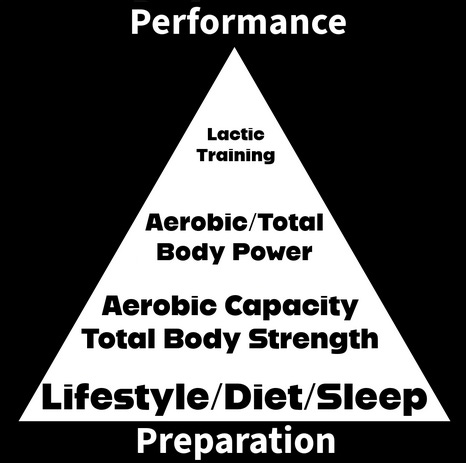
I have used what I call the “Performance Pyramid” in other articles and in my book. This is the summation of how I think long term programming for the combat or tactical athlete should look.
Regardless of what we might be focusing on, we almost always spend time building a huge base of aerobic/work capacity and then for shorter periods add on higher intensity methods in lower volume. This will lead to higher levels of performance and long term progression. The foundation, spring board off of it, and then repeat.
Closing
The challenge with Tactical/First Responders is that we don’t have an off season. However to continue progress we still need to swing the pendulum on what we are focusing on to keep training novel and continue long term progression. With Joel Jamieson’s approval (Phenomenal MMA Strength Coach) I borrowed this graph from one of his articles:
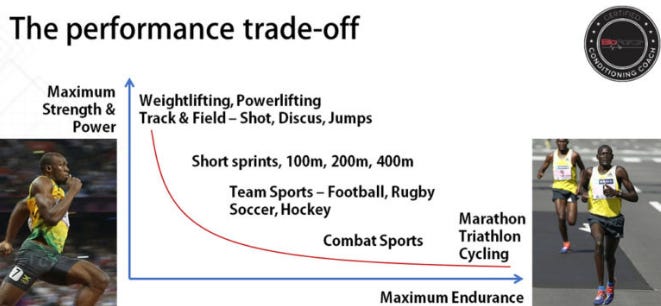
As tactical and first responders we fall somewhere in the middle of the curve depending on mission set. The patrol cop or gang unit can probably float more towards the top of that model, while the infantryman might float more towards the bottom. The point is you can’t go too far in the extremes.
This is why when you look at our current programming, we will spend time building up our base with a ton of moderate intensity general conditioning, interval work, and strength training. These will all be structured in optimal proportions as to not interfere with either adaptation.
Would you make more progress on your conditioning or strength training if you focused on either facet more so than the other? Yes, at the expense of the other. You can do that for a bit,and we sometimes do, but you shouldn’t go too far as you’ll just be leaving performance on the table. You have to at least maintain your other training qualities.
You need balanced training to be the generalist you need to be on the street or battlefield.
Next article we will take a more detailed look into our current phase’s conditioning progression to give you an idea on how we do this. Even if you don’t train with us, this can be a great way to structure your yearly training cycle. Questions? Reach out.
References
Simmons, L. (2015). Special strength development for all sports. Westside Barbell.