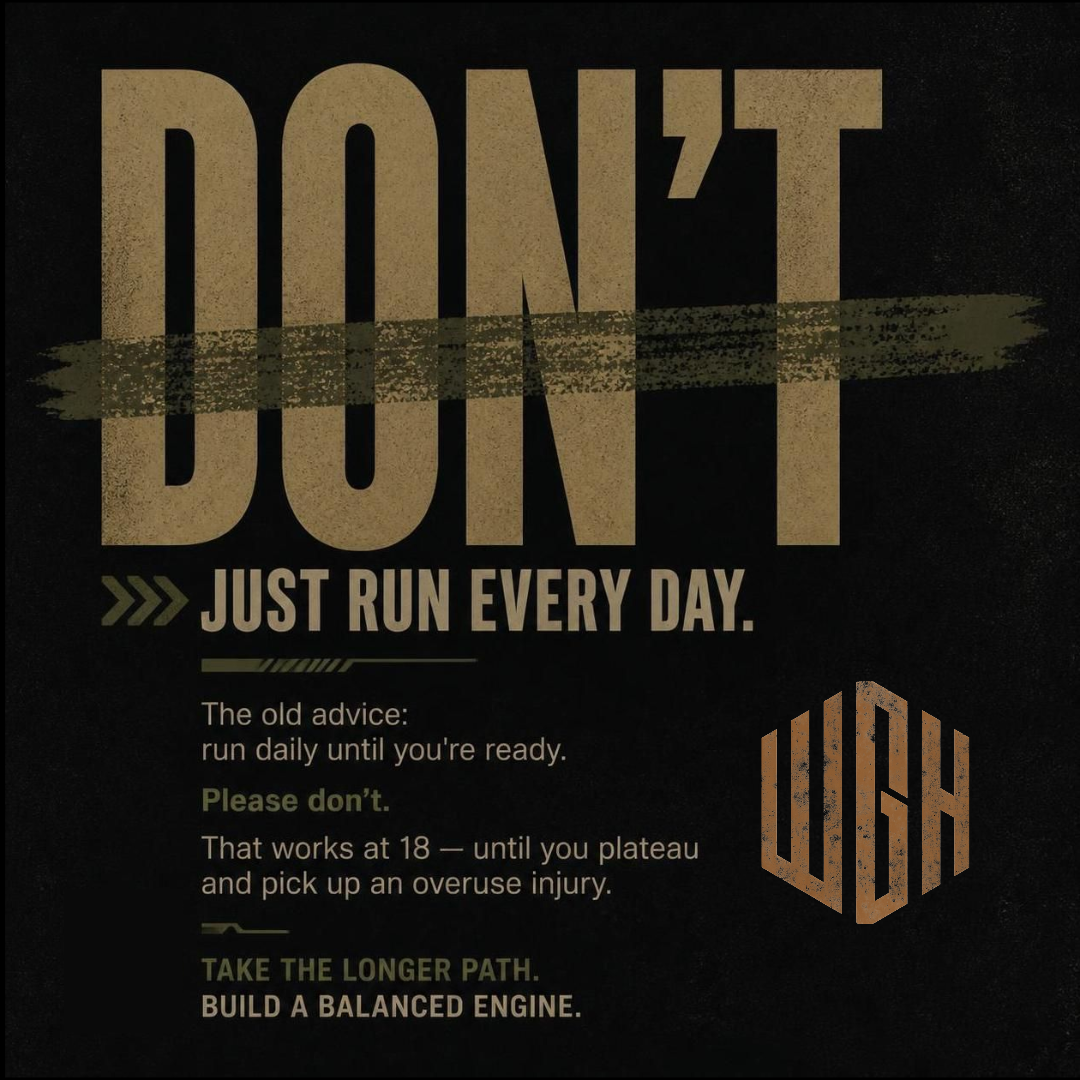

Intelligently build a running base that carries you through the academy — and holds up on the street.
Real Police Conditioning
Excerpt from the book, Answering The Call (cleaned up with AI editing):
“The patrol cop job — the physical and mental requirements — is so unique. I spoke to a good friend of mine who’s still on the job. He told me a while back he had two of his guys get into about a 200m foot pursuit to catch and arrest somebody in 25 degree weather. In the end one guy twisted an ankle and the other swallowed a loose tooth.Really think about that. You’re sitting in your heated car (probably for too long), maybe you’re on nights, you’ve been wearing 20-30lbs of gear for hours, and depending on where you work, most of that weight is hanging off your waist. Then...BOOM…you’re running as fast as you can outside in freezing temperatures to catch somebody in the dark. The person you’re chasing might be armed, might fight you, might even try to kill you, just to get away. You got 1000 things running through your head. What is he wanted for? Is he reaching into his waistband? What did he just throw? Am I going to get sued for this? Will my bosses back me? Is somebody filming me besides my body cam? I hope it’s a good angle when this goes viral...For those of you still in this profession...we all know I’m only barely scratching the surface.”
What I was highlighting above when I wrote the book was the chaotic nature of the profession that police officers deal with every shift. You’re often going from zero to all-out in a moment’s notice. Ironically, in the Academy, most of the physical training you’ll do is exclusively endurance based.
You’ll certainly train on the range and, hopefully, in realistic scenario-based training, but the real-life experience of going from sipping coffee to an all-out sprint is a tough capacity to build.
Training for both the Academy and the quality I’m describing above will require patience, time, and the maturity to understand that not every workout needs you redlining your heart rate on every rep.
The good news: you can start this before you even hit the Academy, and then easily maintain it as you fly from the nest and go protect the public. Putting your time in here will only enhance the higher-intensity work you’ll hopefully be including in future training blocks to keep you progressing.
The Session
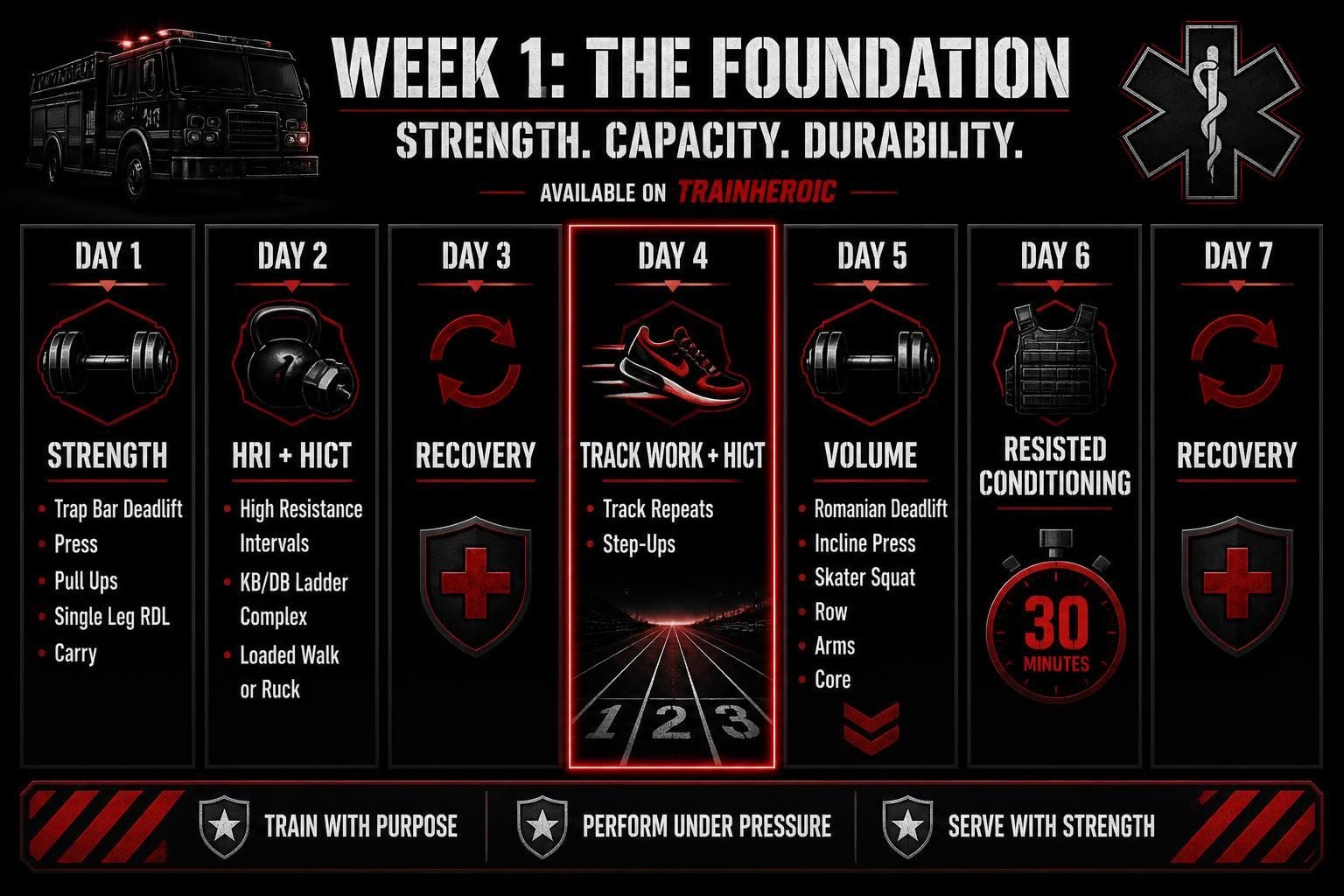
This is again coming from Week 1 of The Foundation. Below is the graphic showing where this sits in the training week. You can reference the first conditioning day (Day 2 of the week) in the previous article. This article is Day 4.
Foam Roll
Hit anything tight. Don’t get too aggressive — spend about 5 minutes working the entire body, with extra attention on the lats, pecs, and glutes.
Warm-Up
Complete as a circuit for 2 rounds:
-
Stationary Bear Crawl (hold position) — 20 sec
-
Forward & Backward Bear Crawl — 10 yards
-
Active Isolated Hamstring Stretch — 8 each
-
Quad Rock w/ Reach — 8 each
-
Bird Dogs (slow and deliberate) — 8 each
-
Side-Lying Clam Drill (add band around knees if too easy) — 8 each
-
Glute Bridge — 8 each
-
Single-Leg Load and Lift (use support if needed; add light load or band if too easy) — 8 each
-
World’s Greatest Stretch — 10 yards
Track Pyramid
Rest roughly the amount of time it takes to run each interval (1:1 work-to-rest throughout, including the cool-down).
-
4 × 100m — Warm-up. Start slow and build speed with each rep. Easy 100m repeats to get the legs turning over.
-
2 × 200m — 70–80%. Push a little harder here. Think a hard jog, still holding the 1:1 work-to-rest ratio.
-
1 × 400m — 80–90%. Move up to one full lap, just a bit faster than the 200s.
-
1 × 400m — Hard, ~90%. This is the whole point of the session. It’s the pace you’d need to chase and fight someone into custody — and still function when you get there. Move with purpose, but be able to perform when you arrive.
-
2 × 200m — 70–80%. Start bringing it down. Back off to two easier-paced 200s.
-
4 × 100m — Cool-down. Very easy now. By the last rep you’re close to walking — still resting 1:1.
Step-Ups (HICT)
Wear a weight vest or hold 15–25 lb dumbbells. Explosive step on every rep — think of it like you’re on a metronome: powerful and rhythmic, not a grind.
-
Duration: 12 minutes this week, building to 20 minutes by the end of the month.
-
Intensity: Keep your heart rate around 150–155 bpm. Once it creeps toward 160, slow down or stop.
Why This Day Works
The one thing you’ll need going in is to know how fast you can run your 1.5 mile — or whatever distance your test requires. The beauty of a session like this is we’re not putting a ton of miles on your feet yet, but you’re still getting in quality work and learning how to pace yourself for your test. These essentially become lower-volume anaerobic threshold and aerobic intervals.
As your fitness improves, you’ll learn how to hold that slightly faster pace while staying aerobic — which is key not just for repeat intervals, but for the sustained effort your test demands.
The High Intensity Continuous Training (HICT) step-ups are a great low-impact addition, because now you’re doing loaded aerobic work that trains your ability to maintain repeated, explosive power over longer time periods. Where we lack the traditional volume of distance running, we make up for it here.
What this means for you: a faster run time, less impact on the body, and better overall work capacity.
Real World Results
When that late-night foot pursuit calls, you won’t just know your “race pace” — you’ll have built the foundation to catch somebody and fight them into custody if you have to.
Sessions like this don’t specifically train the BJJ or boxing that fight might require. But they train the engine and the body, so that when you are working those skills, you’ve got the general fitness to get the most out of it.
Next week we’ll cover the third conditioning session of Week 1 of The Foundation.