
How loaded movement builds durability, recovery, and real-world work capacity for the job
Police, fire, and tactical populations all get familiar with one of the most common experiences in these professions: the moment the event kicks off.
You get called out for SWAT. You rush to throw your gear on, get loaded into the back of a van, and then… you wait.
How long? Who knows. You’re on the drug dealer’s schedule.
Or maybe you’re on patrol, watching a gas station you know is frequented by a certain element. You’ve been sitting there for hours. Through binoculars, you catch an interaction that looks off. You run a plate and it comes back to the girlfriend of a wanted subject with a stack of warrants. You realize it’s him. You try to make a stop as they pull out, and the next thing you know you’re in a foot pursuit in the dark.
You were waiting. Then suddenly, you’re not.
Now you’re in a dangerous situation that could be career-altering or life-altering. All your training gets put to the test on a moment’s notice. Firefighters know their version of this too. It’s just the nature of the job.
Part of the endurance demand in these professions is simply the ability to sit in gear for hours and still be ready. If you’ve never done it, it’s hard to understand how draining that can be. The other side of it is going from near-total rest to 100% effort immediately. Both ends of that equation require the same qualities: endurance, durability, and the ability to display strength and focus while fatigued.
This article covers the loaded movement session in our program, The Foundation. Alongside the other two sessions I’ve already covered in this series, this piece helps build the exact capacity these professions demand — so when the moment comes, you’re ready for it, and when it’s over, you can recover and do it again if needed.
No Shortcuts
Building this kind of endurance takes time, patience, and maturity.
I say that because when I was younger, I didn’t have much patience or maturity when it came to conditioning. I felt like every session had to be a lung-burning test of will. That might build character, but as I’ve said throughout this series, it’s also a good recipe for fast gains, a plateau, and then stagnation or overuse injury.
That’s why following the protocols below matters in this phase.
Loaded Movement
Below is where this session fits into Week 1 of 4.
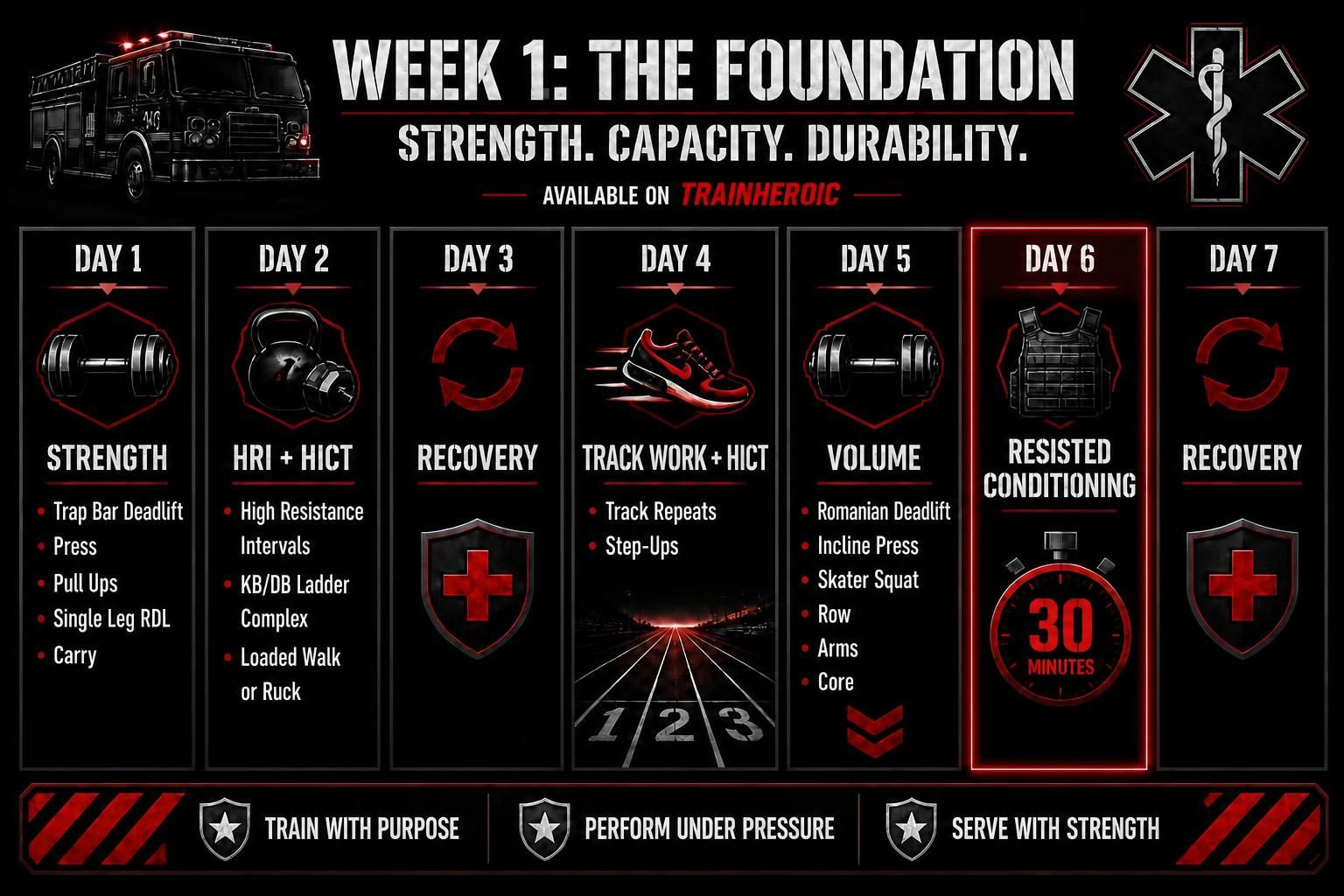
The idea is simple: at the end of the week, we throw on a moderate load and move. We don’t run — yet — because we want to give the body time to adapt to the added force of carrying weight.
Could you throw on a vest and take off running? Maybe. Depending on your fitness level and background, you might get away with it. But I’d argue that’s just cutting a corner that doesn’t need to be cut.
Give your tendons, ligaments, bones, local muscular endurance, and cardiovascular system time to adapt. You’re not slowing progress down. You’re building a stronger foundation.
The Rules
-
Moderate load: This will vary by the individual, but 20–35 pounds plus water is plenty for most.
-
Don’t run: Learn how to walk fast. Most people can move faster on foot than they realize without breaking into a run.
-
Keep heart rate at 115–150 bpm: Your pace should allow you to talk in complete sentences or sing along to whatever music is currently trending. Labored, but controlled.
-
If intensity climbs too high: Slow down or stop briefly until your heart rate settles back into zone.
-
Hold the effort for the programmed time: Don’t turn it into something else.
-
Vary terrain when possible: Add hills, find a trail, change surfaces. Small variations help.
Why This Intensity?
As I wrote in a previous article on the importance of aerobic training:
Training this way allows the heart’s left ventricle to fill with blood, and over time it will actually stretch. If you do this long enough — with enough volume and consistency — this improves the heart’s ability to pump more blood per beat. You’re literally building a bigger engine for your body.
This is why intensity is not a shortcut here.
Yes, hard interval training can improve fitness quickly. But those adaptations can also get capped if you never take the time to build the engine first.
Higher intensities teach the heart to pump harder, which absolutely matters. But when your heart rate is too high, the heart has less time to fill. That changes the adaptation. In strength athletes, for example, you often see the left ventricle thicken in response to the demands of the sport rather than adapt the same way it does with aerobic volume.
So what does that mean in practical terms?
It means you’re building a bigger engine so that when it’s time to move at high intensity, you can stay aerobic longer. That means you can keep working longer before redlining. It also means you can recover faster between hard efforts.
For people in these professions, that matters. A lot.
There’s also a health side to this that shouldn’t be ignored, especially given the cardiovascular risk already present in first responder populations.
Here are a few quotes from a 2013 study on firefighters and sudden cardiac death:
“Sudden cardiac death (SCD) is the leading cause of death in firefighters.”
“Hypertension, including cases with left ventricular hypertrophy, increased SCD risk by 12-fold (95% CI 6.23 to 22.3) after multivariate adjustment.”
“A history of cardiovascular disease and smoking were also independently associated with elevated SCD risk...”
This is a real threat. I’m not a doctor, and I’m not claiming aerobic training alone solves it. But I do believe better cardiovascular fitness gives you a stronger buffer — both for performance and for long-term health.
Closing
Going from nothing to everything is part of the job.
You can’t cram for that test.
Consistent training that builds on itself over time is really the only path to longevity in these professions. Not just surviving the work, but continuing to perform at a high level while doing it.
Don’t just survive. Thrive.
References
Yang, J., Teehan, D., Farioli, A., Baur, D. M., Smith, D., & Kales, S. N. (2013). Sudden cardiac death among firefighters ≤45 years of age in the United States. The American Journal of Cardiology, 112(12), 1962–1967.
Fulton, N., & Rajiah, P. (2017, April). Utility of magnetic resonance imaging in the evaluation of left ventricular thickening. Insights into Imaging.