
Sudden Cardiac Death
Throughout my career I’ve seen two groups typically emerge when it comes to physical preparedness in the first responder or tactical realm. There are the ones who take the job seriously, have a plan, and essentially live the life of an athlete to support their physical performance on the job and the kind of career path they want to have.
But here’s something most don’t talk about: police officers in the United States face 30 to 70 times higher risk of sudden cardiac death during stressful situations—use of force, pursuits, and the various other events officers deal with (Varvarigou et al., 2014). This isn’t just about measuring egos or looking good- although great byproducts of solid training- it’s about real performance, managing stress, and whether you’re healthy enough to actually enjoy the life after the badge.
That’s the context. Here are the two paths.
The Ladder Climber
I never forgot when one of my classmates at the police academy said to me, “I am sure you’ll make Sergeant before I do.” Trying to flatter me for no reason. Always a red flag.
Something I wondered at the time- who said my goal was to promote as fast as possible? You’re telling me your goal is to climb the career ladder as fast as possible before even starting the job. It is fine to want to promote at some point- but maybe understand the job before you ride a desk?
This mindset—already on display before leaving the Academy—spills over into so many other facets of the career. And sadly, after not seeing this individual for several years, I saw a photo and that individual had seriously let their fitness and health go.
By year 10, most Ladder Climbers have drifted. They usually barely pass physical standards. Mediocre at doing the actual job, and before you know it their fitness is gone. They’re managing the consequences: metabolic issues, cardiovascular compromise, a body that doesn’t move the way it used to.
The research backs this up. Officers who let fitness slide are the ones carrying the highest cardiac risk (Varvarigou et al., 2014). This is regardless of rank. If you don’t take this seriously, particularly in the first responder realm, the numbers speak for themselves.
The True Professional
These are the people that if they aren’t packing their meals, they’re at least making the “better” food choice when dining out. They have protein shakes ready to go, and a solid training program to follow that fits their lifestyle.
They are good at the job, and more often than not aren’t just looking to promote—but find specialty assignments that allow them to do the more complicated and hard work- then maybe find leadership roles in those units. They’re looking for opportunities to be challenged more, not just get a larger paycheck, the better hours, and the cubicle.
And here’s the difference: when you see this individual years down the road, they’re still fit. They’re still sharpened. They’re ready. More importantly, they’re still performing- their cardiovascular system is resilient because they built habits early and lived them out through 10, 15, 20 years of shift work and stress.
It Starts in Training—Before the Academy and Beyond
Once you decide—and you decide, as you aren’t forced to join these professions, you have a choice to make on what you want out of these paths. This is where forming habits that will ultimately create a lifestyle that will fuel your performance is what will dictate which officer, firefighter, or tactical professional you become.
This article will focus on the nutrition piece of that equation.
Real World Nutrition
In these professions you’ll work erratic hours, shift work, and often have limited availability of food. The key is you don’t need to worry about being perfect. You just need to make the better food choice most of the time. The good news is if you do that, you’ll feel full, satiated, and won’t reach for the processed junk that is often available when you’re working nights.
Steps:
-
Preparation
-
Balanced Meals
-
Eat Regularly
-
Drink Water
-
Repeat
This doesn’t necessarily mean tupperware containers and hours cooking (although it can), but what it does mean is knowing what to eat, how much, and why. The simplest system I have found to build your meal while on the go is a built-in measuring device most of us have—our hands.
The Hand-Portion Method
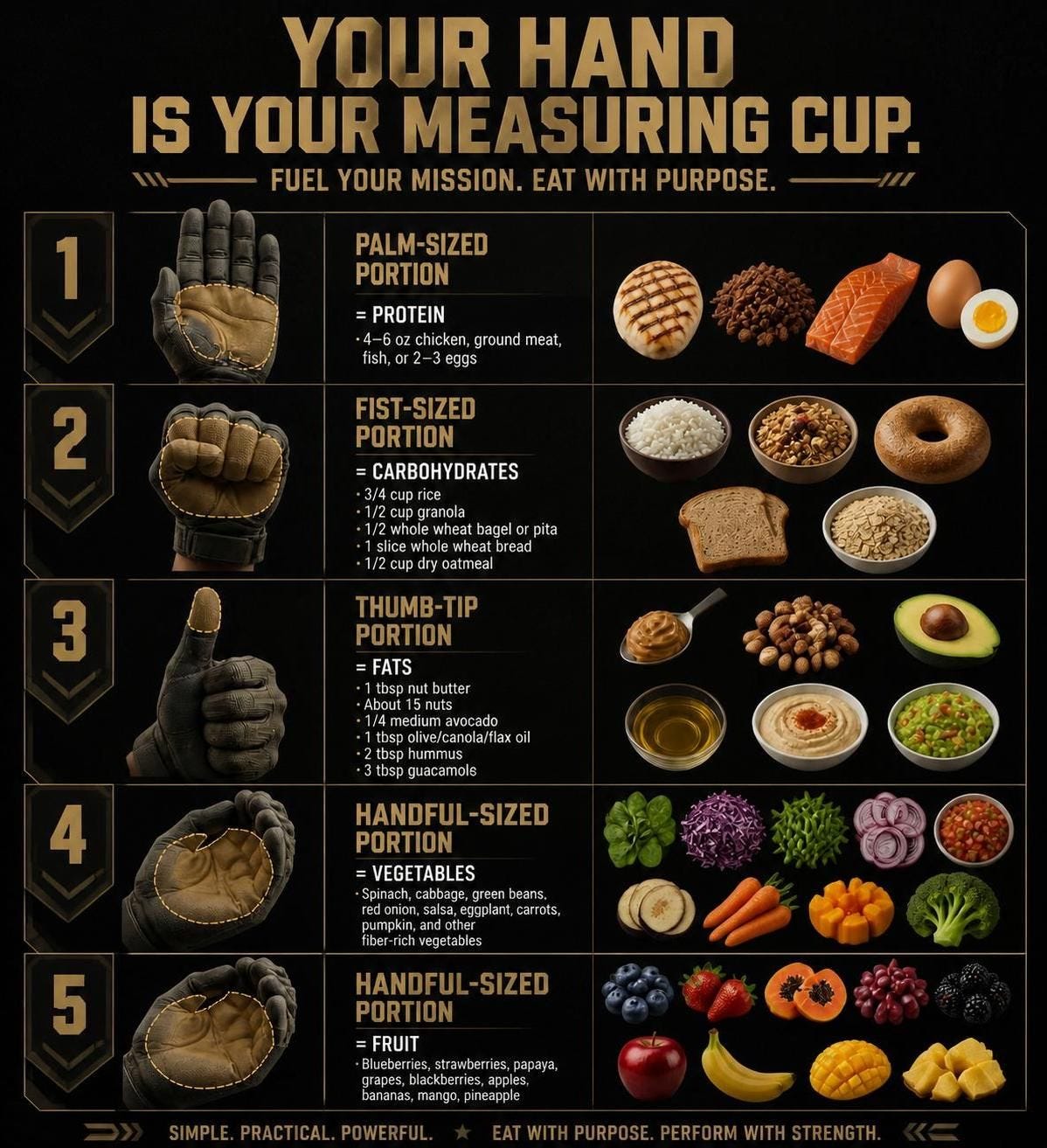
You can see in the diagram above the different portion sizes you can guesstimate with your hand. It is a super simple way to keep your calories under control and build a solid, nutritious meal. One that will keep you full and support performance, fat loss, muscle building—whatever your goals—assuming you tweak this framework to fit your goals.
I suggest for most people for full meals: 2 palms of protein, as many vegetables as you want, and then one serving of carbs and one serving of fat. If you’re super active and lean, maybe more carbs. This is where meeting yourself where you’re at becomes so important.
For snacks: One serving of protein. Again, the rest is goal dependent. Maybe a serving of fat and veggies is where you’re at right now. Or if you’re working out in an hour, maybe it’s a protein shake and a banana. Everyone is different.
Why Each Macronutrient Matters
All of the macronutrients here have value. Stated in the most simplistic way:
-
Protein builds and repairs muscle. It’s your recovery currency after PT and demanding shifts. It prevents the crash that leads to poor food choices.
-
Carbohydrates fuel your training and workouts. Strategic carb intake separates officers who stay fit from those who drifted. You need energy to perform under stress.
-
Fats help repair and optimize hormones (so do the others, but just trying to keep it simple). Under chronic stress—which is your baseline in this job—your hormones need dietary support.
-
Micronutrients are what we get from vegetables and fruits. They keep everything running smoothly.
The key is finding the balance that works for you, where you’re at, at this time in your life. This will all change over time as you become better trained and hopefully leaner.
Benefits of the Hand-Portion System
What’s great about using your hand for your measuring cup is that you don’t have a measuring cup. You have your measuring device with you. This can also apply if you’re eating at a restaurant. Over time you’ll get better at this and you’ll know when you look at your plate how much food you’re eating and whether or not those fries that are staring at you at 1 in the morning is really a good idea.
We Go Home products—portable protein sources, digestion, veggie powders, etc, I call “habit enablers” in this system. They’re tools that let you hit your nutrition targets when you can’t sit down for a meal. A protein source you can grab in 30 seconds prevents muscle loss during shifts and fills the gaps shift work creates.
Why This Matters: Before the Academy, During, and Beyond
Academies are all unique in their own way. Some you’ll stay in barracks and eat in group settings. Others you’ll show up daily and sleep in your own bed. You’ll have some long days, some short days, but generally speaking it will be structured and somewhat predictable.
Everything you just read should be seen as an opportunity. This is the time where you can focus on creating habits in this somewhat controlled environment prior to actually starting shift work and nights. This is where you figure out what kind of meals you like to pack. You get to learn that if you pack some quality protein and veggie powder, when you’re taking a 10-15 minute break between classroom work in the midmorning, how easy it is to deal with your hunger by slamming a protein shake so that when lunch hits you aren’t eating something you shouldn’t.
You learn to deal with the good-natured jabs your peers will give you when they see you mixing up a protein shake and eating some almonds. The amazing thing that will happen is once you look the part, start excelling in physical fitness and other endeavors, those same people might start asking you how you eat throughout the day. This is how you change a culture.
The academy is your window. Once shift work begins—irregular schedules, midnight calls, chronic stress—building new habits becomes exponentially harder. You’re fighting against fatigue, disrupted sleep, and the chaos of the job. The True Professionals don’t wait. They build the habit now, when the environment makes it easy.
Who Do You Want to Be in 10 Years?
Think hard about where you want to be in 10 years. Do you see yourself being the officer that people want as their backup? Do you see yourself getting approached by the member of the SWAT team asking when you’re trying out? Be the physically fit officer that looks forward to the challenges that will face you in these career fields?
Great.
Now think about your daily habits and how you’re going to get there. It doesn’t happen overnight. There is no such thing as a 10-year overnight success story. You need to lay the foundation now. This article is one piece on how you can do that to control your body composition and support your training.
The Real Insurance Policy
But here’s what most articles don’t mention: this isn’t just about the 10 years of your career. It’s about the 20 years after you take off the badge.
Retirement with your family. The trips you planned. The activities you want to do—hiking, playing with grandkids, traveling, living—all depend on the habits you set now. The officers who drifted are managing metabolic disease and cardiovascular compromise- or dead. The ones who built the habit? They’re still here. They’re still moving. They’re ready for life after the job.
The habits you build in the academy don’t vanish. If you learn to eat 2 palms of protein at every meal, you’ll do it even when you’re eating in a patrol car at midnight. If you learn that carbs before a shift or workout improves performance, you’ll be sure to pack portable options that work for you.
The research is clear: officers who maintain their fitness reduce cardiac risk significantly (Varvarigou et al., 2014). The ones who drifted? They’re the vulnerable ones.
This is your insurance policy. And it pays out for the rest of your life.