

Part III — Built for the 20-Year Career: Purpose-Driven Strength for First Responders
I’ll never forget watching a fellow academy classmate lack the strength to properly manipulate the pistol she was shooting on the range. Her hand shook as she tried to work the decocking lever. It was hard to watch, and I remember being genuinely concerned she wouldn’t be able to keep her weapon safely downrange.
The academy instructors remarked to the class—but they were really talking to her—about the importance of strength training, and why even working the ridiculous stress balls they’d issued us would help.
Coming from a graduate assistant strength coach position at a Division 1 university, I never would have thought something like this would be an issue. How could you possibly show up to the police academy in this poor of shape, knowing that in a few short months you’d be on the street enforcing the law?
If you can’t safely manipulate your weapon, how can you defend the public, your fellow officers, or yourself?
We’ve covered several topics in past articles on academy preparation—physicality and nutrition being the last two. This one covers why strength training matters, and how to easily put these principles into your own training.
Strength — Academy Prep and Beyond
Strength and aerobic capacity are the foundation of everything you do. I’ve used this example before, but consider push-ups: the stronger you are on an upper body press, the more push-ups you’ll be able to do—within reason. At some point, pure endurance becomes a factor, as does your strength relative to your body weight. But the main point stands: the stronger you are, the easier an activity becomes.
This article focuses on the strength side of that equation. We’ll tackle aerobic capacity and conditioning next week.
Frequency
I love strength training. I love training in general. If you’re in that camp, this part might be hard to hear, but the reality is that most people entering these professions are best served by dedicated strength sessions 2–3 times a week. That depends on the volume of conditioning you’re doing (we’ll get to that next week), as well as the other types of training on your plate.
For this article, I’m going to lay it out using a two-day model. It’s a manageable starting point, it leaves room for everything else you should be doing, and you can always build up to a third day as your recovery and schedule allow.
You have finite recovery capacity. You can build your tolerance over time, but if you’re also training Brazilian Jiu-Jitsu, boxing, and working nights, something has to give to maintain long-term progress. Your strength training should be augmenting your performance. Your sport is not the gym. That doesn’t mean it isn’t important, or that it shouldn’t be challenging—quite the opposite. But do too much, and you’ll look back over a few months of training and realize you’ve made little progress, if any, no matter how well-meaning those hours in the gym were.
The Breakdown
The simplest breakdown I can offer for a strength training session follows the framework of great coaches like Dan John, along with various collegiate, athlete-focused programs.
This doesn’t mean every human movement gets trained as hard as possible every day, but you’ll find the following in almost every one of our sessions on TrainHeroic:
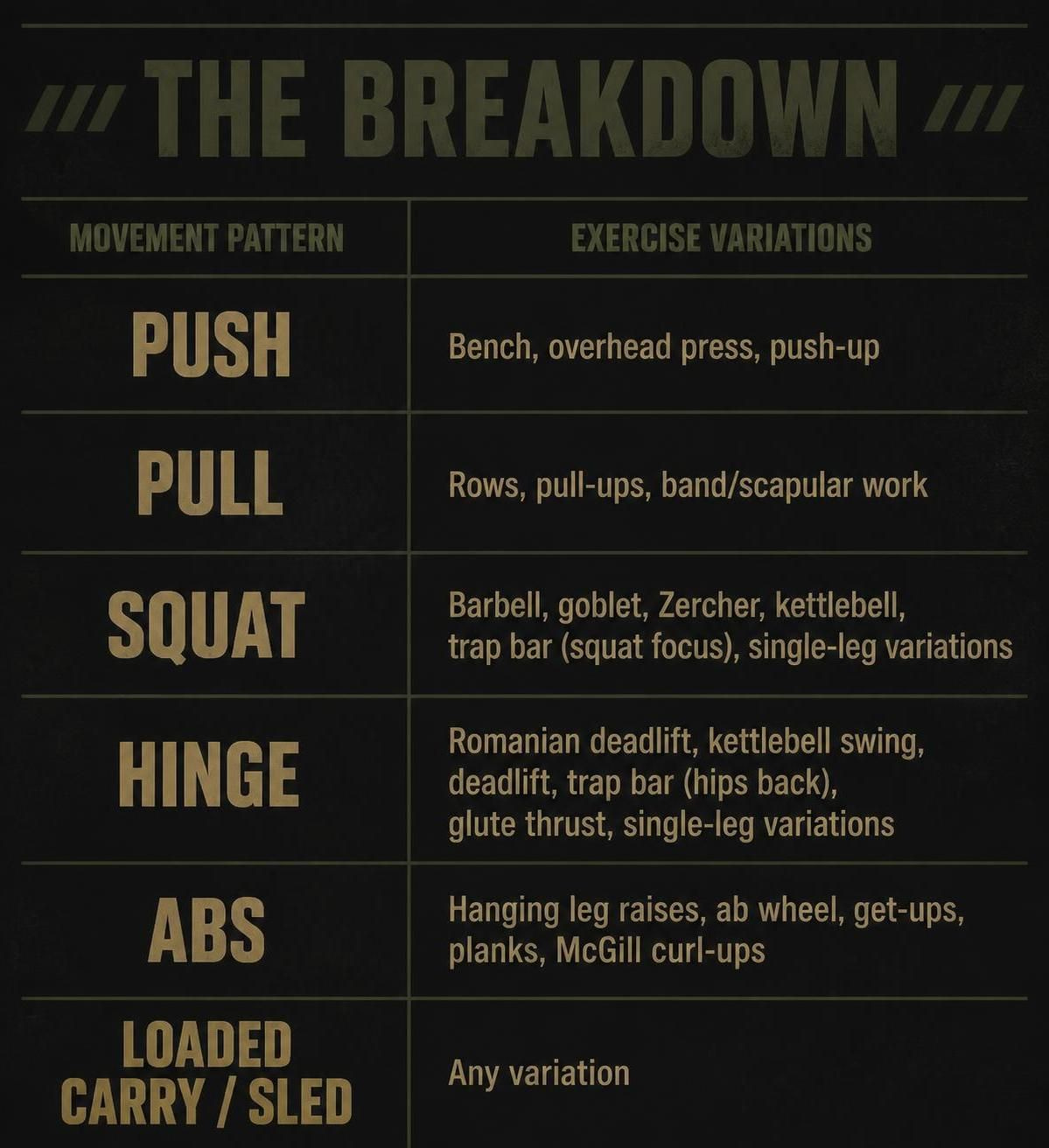
Academy Preparation Strength Training Principles
Although this focuses on academy preparation and building the foundation for your career, it doesn’t mean you can’t keep getting phenomenal results over the long haul—with a few tweaks here and there as you get stronger and more fit. The biggest thing you’ll change is usually the tool you use to develop your strength.
At first, some people get great results using nothing but push-ups and goblet squats for their upper and lower body movements. Eventually, though, you’ll get strong enough that loading those movements becomes difficult and time-consuming. That’s where the trap bar, bench press, landmine press, and other implements become more practical. It doesn’t mean the bodyweight movements lose their value—it just means that strapping 100+ lbs of extra load onto a push-up is a pain, and not everyone has the right equipment to do it.
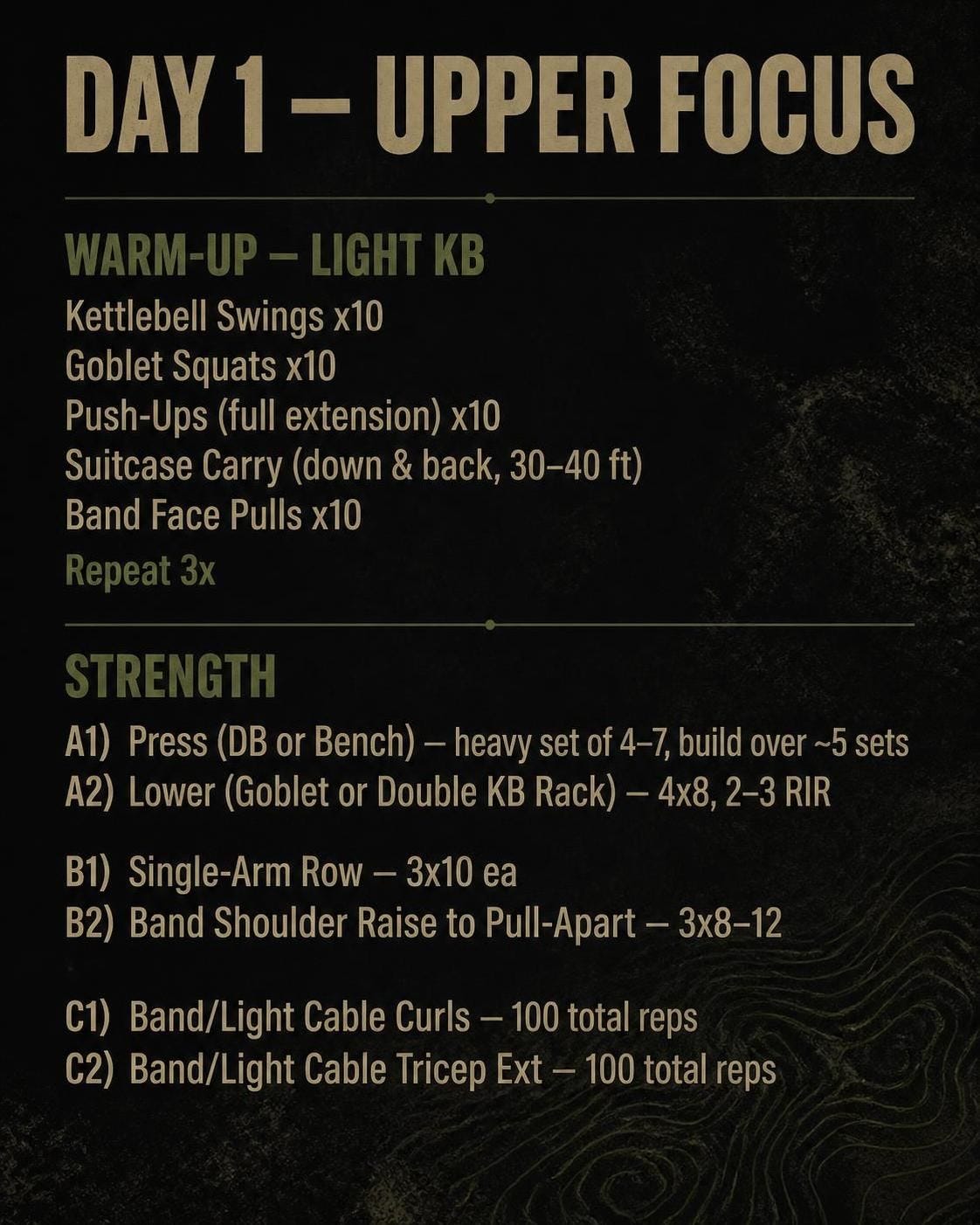
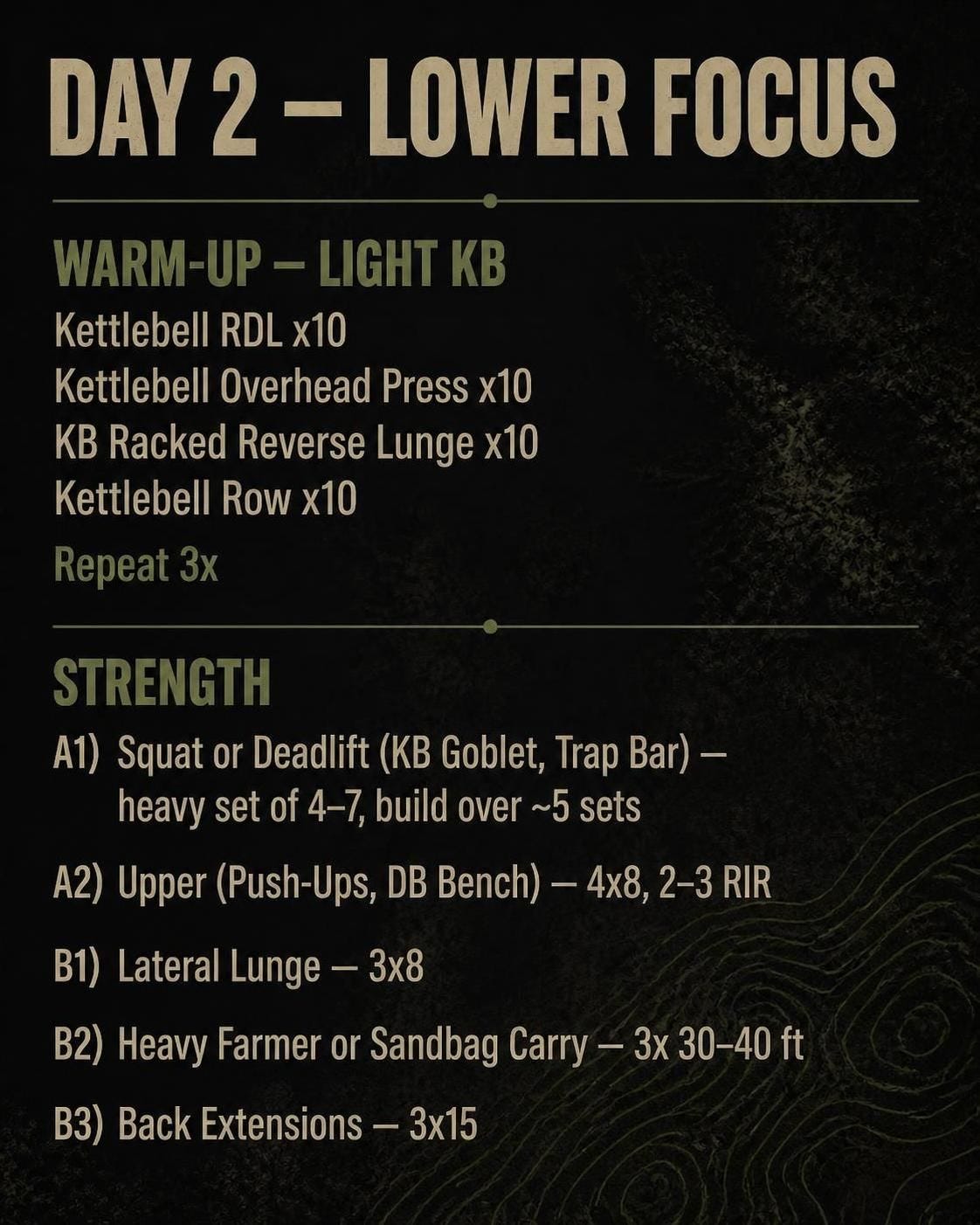
The 2-Day Split — First 4–6 Weeks
The first four weeks set the foundation for harder training. The focus is building strength with a main upper and lower body movement each training day. On your upper-focused day, you’ll superset a lower body movement in a “muscle-building” rep range, then follow up with upper accessory (or assistance) movements to build some muscle and capacity. We’ll flip that setup on your lower-focused days.
This is designed for a Monday/Thursday schedule—or whatever fits your week, as long as you put about 48 hours between each strength day.
Your other sessions will be conditioning, kettlebell work capacity, and ideally some boxing or BJJ. This is exactly why you’re only doing true, heavy strength work twice a week during this phase. You’re doing a lot—or at least you should be. You can still make great progress in the weight room with this setup without neglecting other critical physical capacities or skill sets.
Again, we’ll cover the other training days in the next chapter, but here’s your strength work:
Key Notes
We incorporate all the human movements, whether in the warm-up or the primary block of the session.
This is meant to be progressed. Each week, on your main strength movement, strive to do slightly more weight, more reps, or both. Take these movements to a point where you could probably get one more rep, but not two. Treat accessory work the same way, but leave a couple reps in reserve.
Your main movements should reflect where you’re at in your journey. If you’re getting back in the gym after a several-year hiatus since your high school football days, you probably shouldn’t open your lower body day with low-bar back squats. At first, maybe you grab a dumbbell or kettlebell and do some goblet squats to a bench.
Closing
This is a very basic strength template, designed to complement a holistic training system that gets you ready for the police academy and beyond. It isn’t meant to be a standalone two-day program where you do nothing on your other days. I’ll provide those sessions next week.
Depending on the type of academy you’re attending, you may have time to train on your own. That’s where you weigh the physical training the academy is already putting you through, and figure out how to plug in sessions like these to complement what the instructors have you doing.
If you’re attending a full-time academy that looks more like basic training, then a program like this ends the moment you check in. You’ll just do what they have you do. But this is still a great framework to return to as you enter the force and start field training.