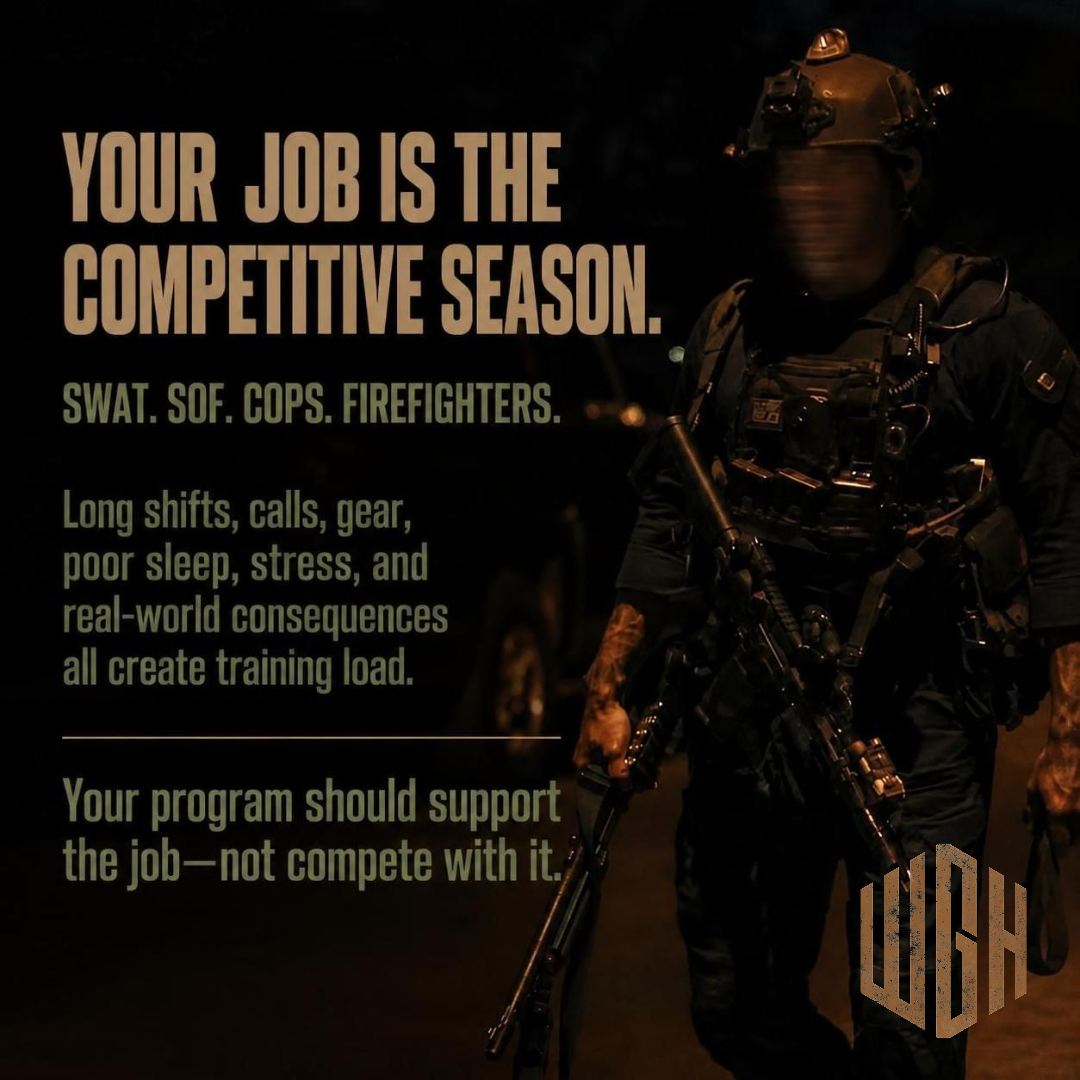

How police officers, firefighters, and tactical professionals can increase training demands while remaining prepared to perform at a moment’s notice.
Our last article touched on how you would train if you knew the most demanding call of your career was in 24 hours. The obvious answer is that you’d be well-rested, well-fed, hydrated, and recovered to the best of your ability. You’d know what tomorrow brought, whether you were responding to an active shooter, fighting for your life on the side of the road with a wanted subject, or carrying people out of a burning building.
Obviously, you don’t know when any of this might happen. With that said, there is room to apply the seasonal training models commonly used in collegiate football. They generally include:
Summer/preseason: A longer training block consisting of strength, conditioning, power, agility, and skill practice.
In-season: Weight-room and dedicated conditioning sessions are limited, especially for athletes seeing the field. Practice and game readiness become the priorities.
Spring ball: A shorter training block that combines lifting, conditioning, and skill practice in preparation for the upcoming season.
This article will focus on the “off-season” model. The irony is that first responders and tactical professionals do not have an off-season. You have the enduring task of being available at a moment’s notice to protect the community, respond to a structure fire, or handle whatever unknown event comes next.
I will still argue that there is a time and place to push the envelope—responsibly—without blaming your workout and sore legs for getting dusted on a foot pursuit.
Real Programming vs. Theatricality
If your program requires certain exercises regardless of context, constantly takes lifts to failure or forced reps, or designs every conditioning session to create fatigue rather than achieve a specific purpose, you’re not following a program. You’re following marketing and chasing the emotional satisfaction of feeling like you worked hard.
Let time-tested data and results dictate how you train.
Summer or Preseason Training
Preseason training for collegiate football players is a time to build strength, muscle, and conditioning without the demands of games eating into recovery. This is when we start putting the armor together.
Compared with in-season training, this usually means greater volume and harder training. The metrics we focused on were straightforward: lifts increased and run times decreased.
Even though first responders and tactical professionals never have a true off-season, there can still be periods when you increase your training demands. You can do that by adjusting:
-
Volume
-
Intensity
-
Proximity to failure
-
Frequency
-
Training modalities
This doesn’t mean being so reckless that it takes days to recover from every session. It also doesn’t mean stacking high-intensity days throughout the week. It means adding a little more when life allows.
Volume
You can add volume by increasing sets, reps, or time. Let’s say you work up to a 400-pound set of five on the trap-bar deadlift. You know you had one or two reps in the tank, but you weren’t sure whether your form would hold up, so you ended the set.
You’re still feeling good, and your other workouts have been going well. Instead of adding weight, take 90% of 400—or 360 pounds—and perform two more sets of five. You could also perform five sets of two while focusing on perfect reps and greater speed.
You’ve added more work for your body to adapt to without making it difficult to walk up the stairs the next day.
For conditioning, this could mean adding 10–15 minutes to your Zone 2 days or rucks. It could also mean adding a few sprint intervals while maintaining the same recovery periods. Start with roughly 10–20% more than you originally planned.
Intensity
Intensity is usually the first thing people increase. I would argue that it shouldn’t be your first stop most of the time, particularly if you have some gray in your beard.
Add a little volume first. When it’s time to increase intensity, maybe you hit 400 for five on the trap-bar deadlift. It was heavy, but you’re feeling good, so you add 10 pounds and perform another set of five—or a heavy triple.
For conditioning, this could mean spending more time near your threshold or including some high-intensity intervals with incomplete recovery. It depends on your training phase. You don’t want to spend too much time on high-intensity work if you’re also trying to increase your lifts. For our population, adding time to aerobic or threshold work is usually the best place to start.
Proximity to Failure
I do not believe first responders and tactical professionals should routinely take lifts to total failure. That doesn’t mean you don’t push yourself. Once rep speed slows substantially, I would usually end the set.
Excessive soreness does not equal a superior workout. Soreness may tell you that a session was novel or demanding, but it is not a reliable measure of training quality or better results. Again, check your emotions.
More importantly, you don’t want to be excessively sore when you have to chase someone, fight someone, or carry gear up several flights of stairs while people need your help.
When you’re feeling good, you can push closer to failure, particularly on accessory or assistance lifts. When you’re run-down, there is nothing wrong with getting quality work in while staying farther from failure.
Frequency
Frequency is simply how often you train, and it is often abused. One way to add more is to include a short, extra workout somewhere in the week. This does not mean repeating a full session.
Use that time for a few drills on the heavy bag, 10–20 minutes of light sled dragging, additional Zone 2 work, or some bodyweight exercises throughout the day. The latter can be an effective way to practice movements that appear on your PT test.
If these small workouts are not abused, they can increase work capacity over time. A truly aerobic session may also enhance recovery. If it turns into a gut-wrenching sprint workout or your third sparring session of the week, you have defeated the purpose—and may end up injured.
Chosen Modalities
This is highly individual. It could mean adding traditional sprint work instead of relying on the bike for conditioning. It could also mean emphasizing heavy compound lifts rather than using sled work or single-leg exercises as your primary lower-body movement.
Your modality should reflect where you are in your training cycle, what you need to improve, and what your body can currently tolerate.
Closing
First responders and tactical professionals do not have a traditional off-season, but there is still plenty to learn from the way collegiate football programs structure their training. You can add more without derailing your recovery, assuming you do it responsibly and remember that you may need to perform at a moment’s notice.
Even if you’re preparing for SWAT or another selection, you can monitor your training based on your daily demands and stress levels. Adding stress on top of stress does nothing for you, no matter how mentally tough you believe you are or what self-help book you’re reading.
Eventually, it catches up with you. At best, your strength and conditioning stop improving, and your body composition may suffer. Then your sleep deteriorates, you feel wired and exhausted, your lifts regress, or you get injured.
Add more when you’re recovered, but not so much that you can’t recover. Monitor your performance, sleep, resting heart rate relative to your normal baseline, and subjective readiness.
If your lifts aren’t improving, you can’t cover more ground in less time, and your readiness markers are moving in the wrong direction, ask whether you should still be training like it’s your “off-season.”
If your hardest call were tomorrow, could you perform when everything was on the line?
If you’re not sure because you decided your emotions and your workout were more important than your actual mission, reevaluate your priorities.
In the next article, we’ll discuss why spring-ball and in-season training concepts are usually closer to where you need to be when working in these professions.