
Stop fighting your physiology with poor lifestyle choices
Key Takeaway
Whether you’re at selection, responding to a structure fire, or confronting a robbery in progress, stress is inevitable. These high‑stakes moments can be career‑ and life‑altering—the difference lies in how you respond. The goal is to respond like the professional you are.
But what if your sleep, training, and lifestyle choices are setting you up for failure? Why not borrow from what athletics has learned about peak performance and actually train and live to enhance it—instead of continuing to dig a deeper hole? That’s what this article addresses.
Our Physiology
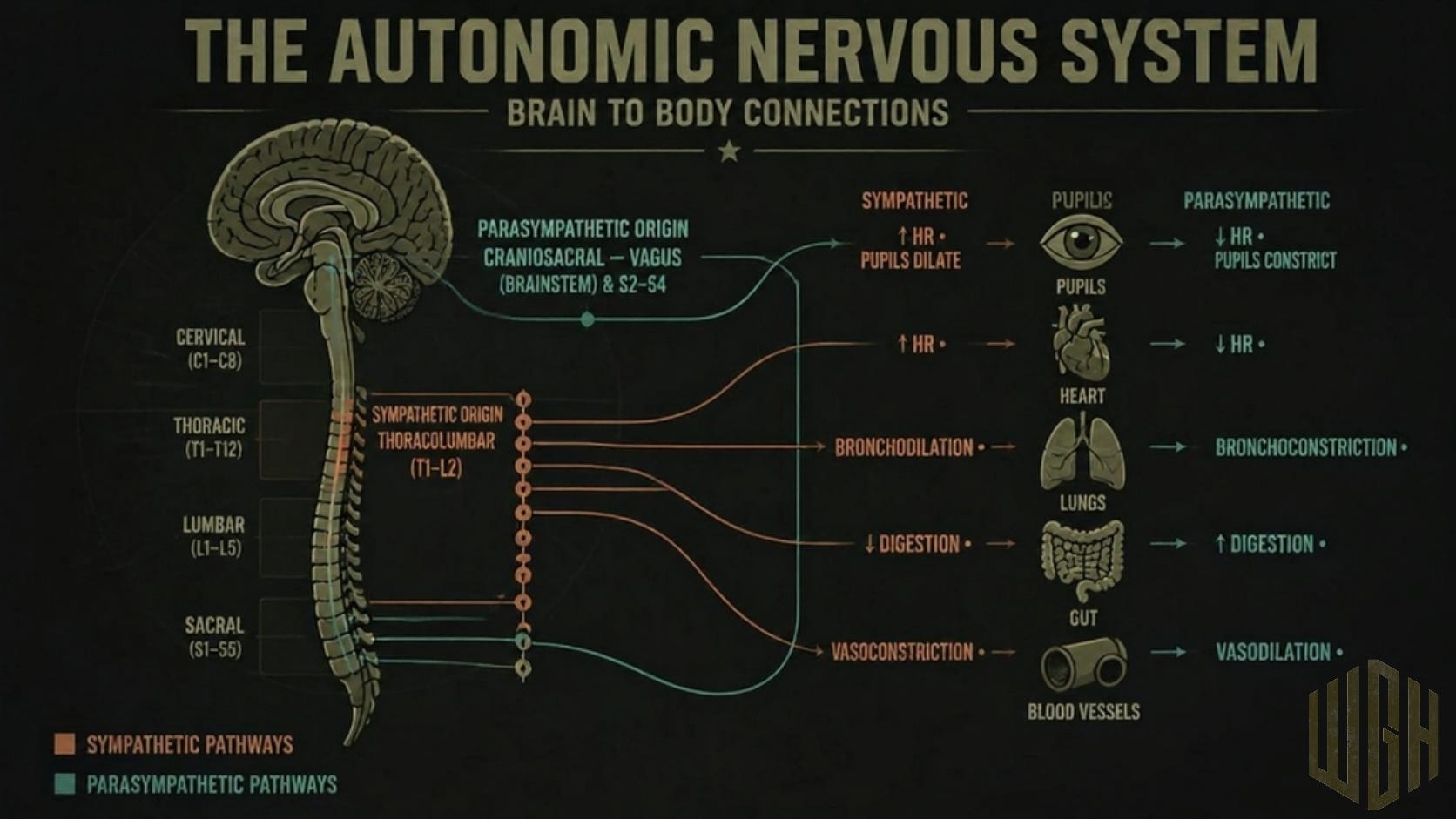
The diagram above illustrates the autonomic nervous system and its two states: parasympathetic (resting) and sympathetic (stressed). Think of it as a background computer that automatically reacts to circumstances. It runs without conscious input—but that doesn’t mean it’s unchangeable.
These responses are automatic. However, solid military and first-responder training demonstrates something crucial: we can learn to partially control them.
Proper tactical training and scenario-based work expose us to stress in a controlled environment so we learn to find that balance. We can tap into the benefits of our sympathetic response when that suspect on a traffic stop is trying to kill us—but not so far that we lose control and can’t make sound decisions in the moment.
But what if we are always stressed?
Tactical professionals need a strong, controlled sympathetic response—whether during selection or on the job—followed by strong recovery afterward. I’d argue this is why so many police officers suffer heart attacks: poor fitness and lifestyle choices combined with immensely stressful events. Their bodies can’t handle the constant ups and downs.
Another issue we see in these professions is the overuse of energy drinks and caffeinated beverages. There’s nothing wrong with strategically using caffeine for performance. However, the pattern is problematic: coffee all night to stay awake during a shift, poor sleep that’s already disrupted by shift work, then doubling up on caffeine with pre-workout before the gym. You’re quickly accumulating dangerously high levels of stimulants.
This shifts your body into a chronic sympathetic state—you’re always stressed. Do this long enough and you’ll inevitably crash. The weights in the gym feel heavier. You convince yourself you’re still working hard even though you’re not. And you never recover. This isn’t sustainable for a 20-year career.
Breaking the Cycle
There are a few ways you can mitigate this. First, monitor your caffeine intake and consider using a non-stimulant pre-workout for a few weeks. This lowers your overall caffeine intake for the day.
Another approach is to train properly with a solid workout structure. As discussed in earlier articles, too many high-intensity days per week will lead to chronic fatigue. That isn’t toughness—that’s just stubbornness. I say this as someone who did it for years.
Real World Results
It’s important to understand that the two branches of our autonomic nervous system—sympathetic and parasympathetic—aren’t inherently good or bad. Both have critical roles. It’s all about balance.
Elite athletes, even in violent sports, tend to be parasympathetic dominant. That doesn’t mean they compete half asleep—it means their nervous system naturally shifts back to parasympathetic recovery when they’re not competing or training. Their default is calm, even though they’re capable of performance under incredible pressure.
A 2025 study demonstrated something striking: soldiers were significantly more likely to pass intense military selection if they had higher Heart Rate Variability (HRV) scores. HRV correlates with aerobic fitness, lower resting heart rates, and stronger parasympathetic tone. Here are the key findings:
-
The mean HRV in those who passed selection was significantly higher than those who failed
-
High combat fitness, suitability to combat service, psycho-technical scores, and low resting heart rate significantly predicted passing
-
Soldiers who passed averaged a resting heart rate of 57 bpm
-
Soldiers who failed averaged a resting heart rate of 64 bpm
Closing
This is just one study, but others show the same pattern: high performers are typically more parasympathetic dominant. This article covered the basics of the autonomic system, why it matters, and the lifestyle factors that determine where you fall on this spectrum. The next article will address how a properly designed training system doesn't fight this physiological reality—it works with it.
References
Kula, Y., Iversen, Z., Cohen, A., Levine, A. D., & Gidron, Y. (2025). Does vagal nerve activity predict performance in a naval commando selection test? Applied Psychophysiology and Biofeedback, 50(3), 349–357. https://doi.org/10.1007/s10484-025-09702-4