
How to Maintain Peak Fitness With Multiple Orthopedic Surgeries and the Wear and Tear That Comes With This Lifestyle
Key Takeaway
I randomly decided to measure my resting heart rate the other day—it had been months, if not years, since I’d checked it last. I was shocked to see it hovering around 46-47 bpm.
What surprised me most is that my training this past year has focused on building strength through variation, boxing, and aerobic conditioning. I don’t do distance running or intense lactic intervals. Instead, my conditioning work centers on aerobic base building and anaerobic threshold work. I honestly expected my RHR to land in the mid-50s—which isn’t bad, but nowhere near what I was seeing.
Looking at how elite athletes across different sports stack up, here’s what the data shows:
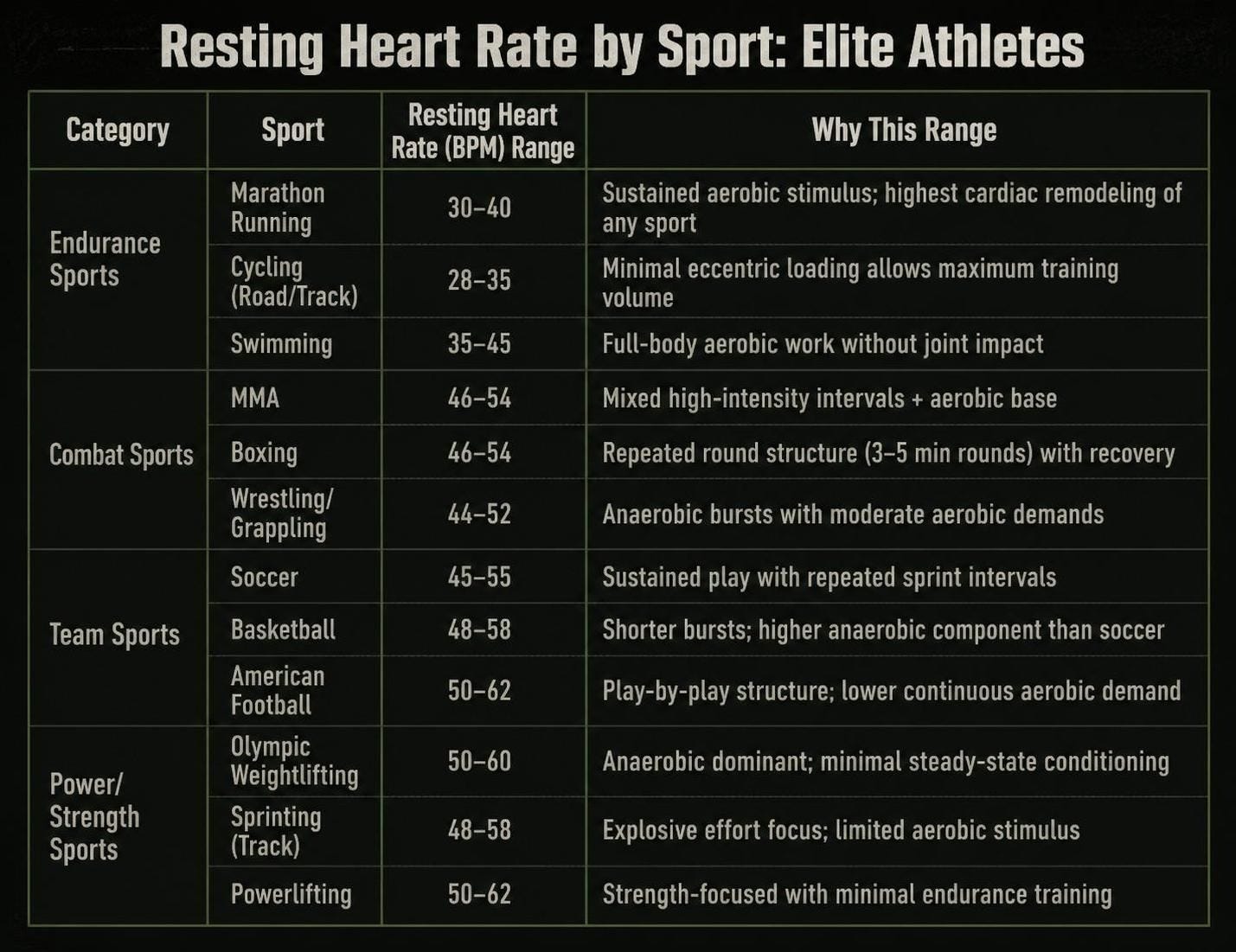
I’m not elite in anything, but I was pleased to find myself in the range of elite combat athletes—especially at 41 years old. My strength continues to progress across various movements, and aside from the occasional old-man back tweak, I’ve stayed healthy.
This is particularly gratifying given my medical history: a hip replacement, medial meniscus removal from the knee on my surgical side, and right elbow debridement (which left it inherently unstable and arthritic). Seventeen years of police work, time in the Ranger Regiment, and other military service will do that.
So how did I build elite-level aerobic fitness without running or being elite? Through a combination of biking, sled work, kettlebell training, and boxing—all programmed intelligently and strategically throughout the week.
Training Zones & Structure
Regardless of the activity, intensity, volume, and timing within the training week are what matter. Here’s my current setup:
-
3 lifting days per week: Upper body, lower body, and total dynamic effort
-
1 boxing session: Structured class or heavy bag work
-
2 conditioning days: Threshold or Zone 2 aerobic base building
For a 41-year-old, here’s how my intensity zones break down (these are estimates):
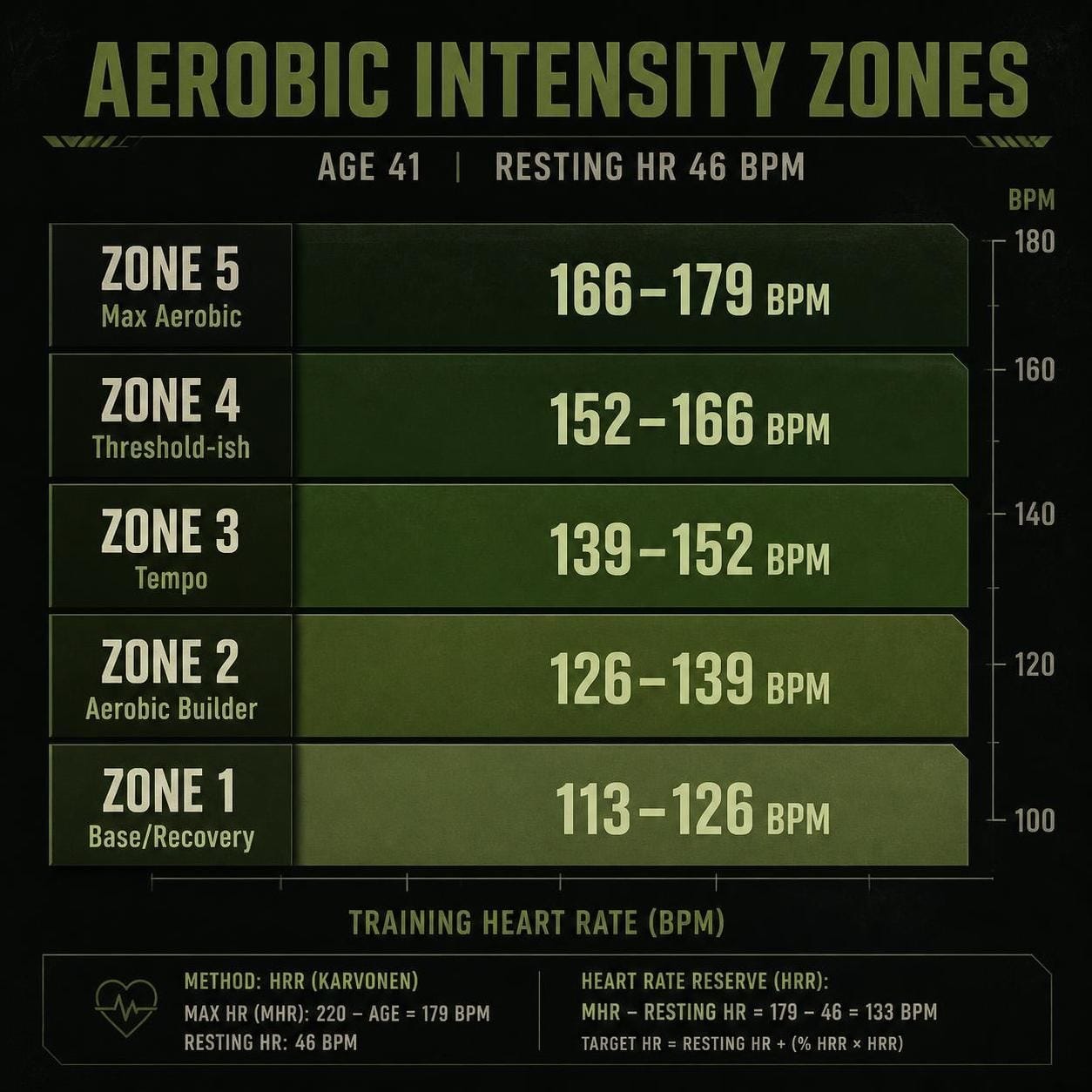
You can calculate these zones above using a lot of different formulas, but honestly, plug your data into an AI tool and let it generate the chart for you—it’s faster and these are going to end up being general ranges you’ll work in regardless.
Here’s how I structure a training cycle:
Day 1: Max/Heavy Effort Upper
Day 2: Boxing Class or Heavy Bag Work (usually aerobic, transitioning to threshold)
Day 3: Max/Heavy Effort Lower
Day 4: Zone 2 or Threshold Intervals w/Full Recovery (Bike, Band Work, Sled)
Day 5: Dynamic Effort—Weighted Jumps, Speed Press
Day 6: Zone 2 (Sled, Bike, Band Work—or Off depending on schedule and how I feel)
Day 7: Zone 2/OFF
Day 8: Tempo Intervals, Medicine Ball Throws, Track-Style Skips
Day 9: Restart the cycle
Yes, that’s 9 days, not 7. Each day is designed not to interfere with the others, and recovery days are built in. If my schedule is demanding, I’ll stretch the cycle to 10 days to ensure quality on the main training days.
The key here is that none of this is set in stone. If for some reason I am not feeling recovered or if life happens I will swap around low intensity days to make this fit where I am at on a given day. When I don’t do this, I usually end up having a mediocre session and I just wished I listened to how my body responded to the previous training sessions.
For example, if my boxing session was particularly demanding and the following day I don’t feel recovered, I’ll just do some low impact zone 2. Then the following day I’ll do my lower body workout. I encourage this strategy even when you’re following our program on TrainHeroic.
Why This Works: Sustainability
I’m not elite in anything. My goal is maintaining high general fitness without excessive wear and tear—and being ready to perform when called upon. For tactical professionals, you don’t know when you’ll need to perform.
I say this in nearly every article, and younger tactical athletes still tell me our training “isn’t enough” based on one session they saw. I’d have said the same thing in my twenties.
What they’re missing is the bigger picture. Everything we do is nested in a yearly training cycle designed to build strength and conditioning for a 20-year career—not for the isolated satisfaction of puking through one brutal session that wrecks the rest of your week. Many of them also haven’t experienced working nights or the cumulative stress of these professions. They’ll understand eventually—hopefully before tendonitis sets in, or worse: injury, getting gassed on a foot pursuit because you were too sore to move, or losing a critical moment when it matters most.
The philosophy behind our programming at We Go Home Human Performance is simple: make progress while staying capable of performing when you’re called. Whether you’re a cop on the beat, a SWAT officer mobilized at 2 AM, a firefighter on a never-ending shift, or a parent defending your family—excessive soreness and fatigue will compromise you.
Intelligent programming matters. When you’re ready, we’re here to help. Questions? Reach out.