
How long should First Responders and Tactical Populations rest between sets or reps (or rounds) during conditioning?
Key Takeaway
Tactical populations and First Responders are often inundated with workout programs that have limited rest periods between sets, reps, or rounds. With the constant pressure of being in a “tough” profession, rest periods are sometimes viewed as some form of weakness. The reality is proper rest periods are extremely important to illicit the adaptations most trainees seek.
This article will discuss this topic from the perspective of a Conditioning or Endurance focused training session.
Conditioning
When it is time for energy system development (ESD) this is often where Tactical and First Responders feel like they always need to be on the edge of death. Like everything, there is a time and a place for such sessions. Typically this is when we are training our lactic system or going for VO2 Max, but even during those sessions there are usually rest periods in order to actually be able to perform on each of the working sets.
Power vs. Capacity
It is extremely important to understand the difference between power and capacity when we talk about conditioning or even being able to repeat heavy strength efforts. Power is the general ability to display something quickly and as forcefully as possible. Capacity on the other hand, is the ability to repeat the effort. Ideally if your capacity is high you can continually display whatever the effort is at a high level, but usually not at peak velocity or power.
Think of an MMA fighter or a boxer early in the fight. Those power shots in the beginning are generally more devastating. As the fight continues the fatigue and stress build up and there is some power drop off. The fighter with higher capacity and conditioning is typically the one who can keep throwing hard power shots. We have all seen extremely powerful athletes who are known to be killers in the first few rounds but if their opponent can survive later into the fight, the better conditioned fighter has a better chance of winning.
Tactical and first responders need a balance of both. To train this properly, one should build strength/power first, and then later in the training cycle work on the ability to maintain said power. You need the fitness and power first before trying to build the endurance to display it multiple times. Unfortunately most start with the endurance (capacity) first because those sessions feel harder.
Example: Conditioning Focus
In our programming we often program something called High Resistance Intervals. These are resisted short burst efforts followed by full recovery.
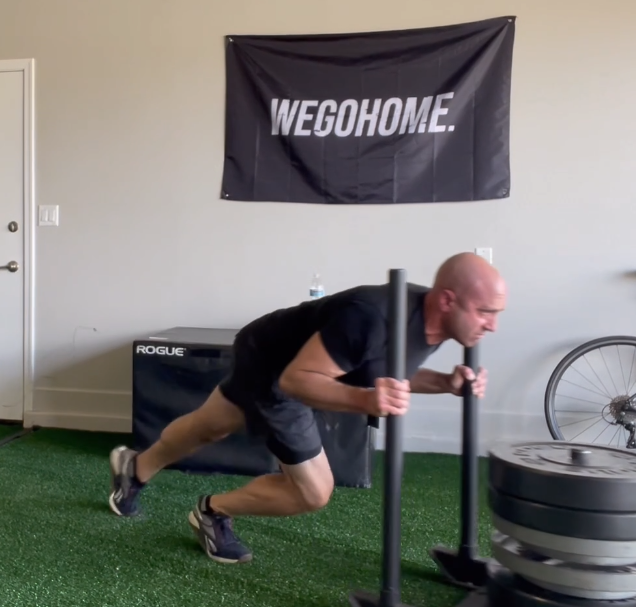
I’ll use a sled push as an example. Ideally wear a heart rate monitor and push a loaded sled a distance that takes you roughly 10-15 seconds to cover. Wait for your heart rate to return to 130-140bpm or so, then go again. Rest at least 1-2 minutes at first in the beginning of the session. Once fatigue starts to build this is where using your heart rate becomes valuable.
Why?
You’re training your ability generate as much total body force as possible on each rep. If performance is maintained you can build up to 20+ reps depending on your goals. Just keep your speed/power output high. You shouldn’t be just trying to survive these and moving at painfully slow pace. Each rep should be powerful. Once fatigue seriously builds stop the session for the day.
This is the “out of the sprinter blocks” of a foot pursuit energy system. As a cop this is perfect for training your starting speed. Now once you’ve built yourself up to 15-20 reps of these and you’re recovering between sets easily you can add a density component. This will now train your capacity to repeat this ability.
For training capacity you can now do these every minute on the minute regardless of heart rate. Once this is easy do a rep every 45 seconds. Then 30 seconds…you get the point.
You can’t build to this if you don’t respect the rest between each rep. You’ll just be throwing things at the wall. That works for everyone at first, but at some point you’ll be more trained and you’ll need more structure.
Closing
Again, you’re not being weak by using the appropriate rest periods for your goals. What I outlined above isn’t necessarily an “easy” workout although in the beginning of the cycle you won’t be looking to puke during these sessions.
However, as the weeks go by and we start to manipulate the rest periods you’ll see what building your fitness actually looks like. You’ll enhance qualities like power and in turn become more physically capable for the profession.
Questions? Please reach out, comment below or try our programming with a 7-day free trial.