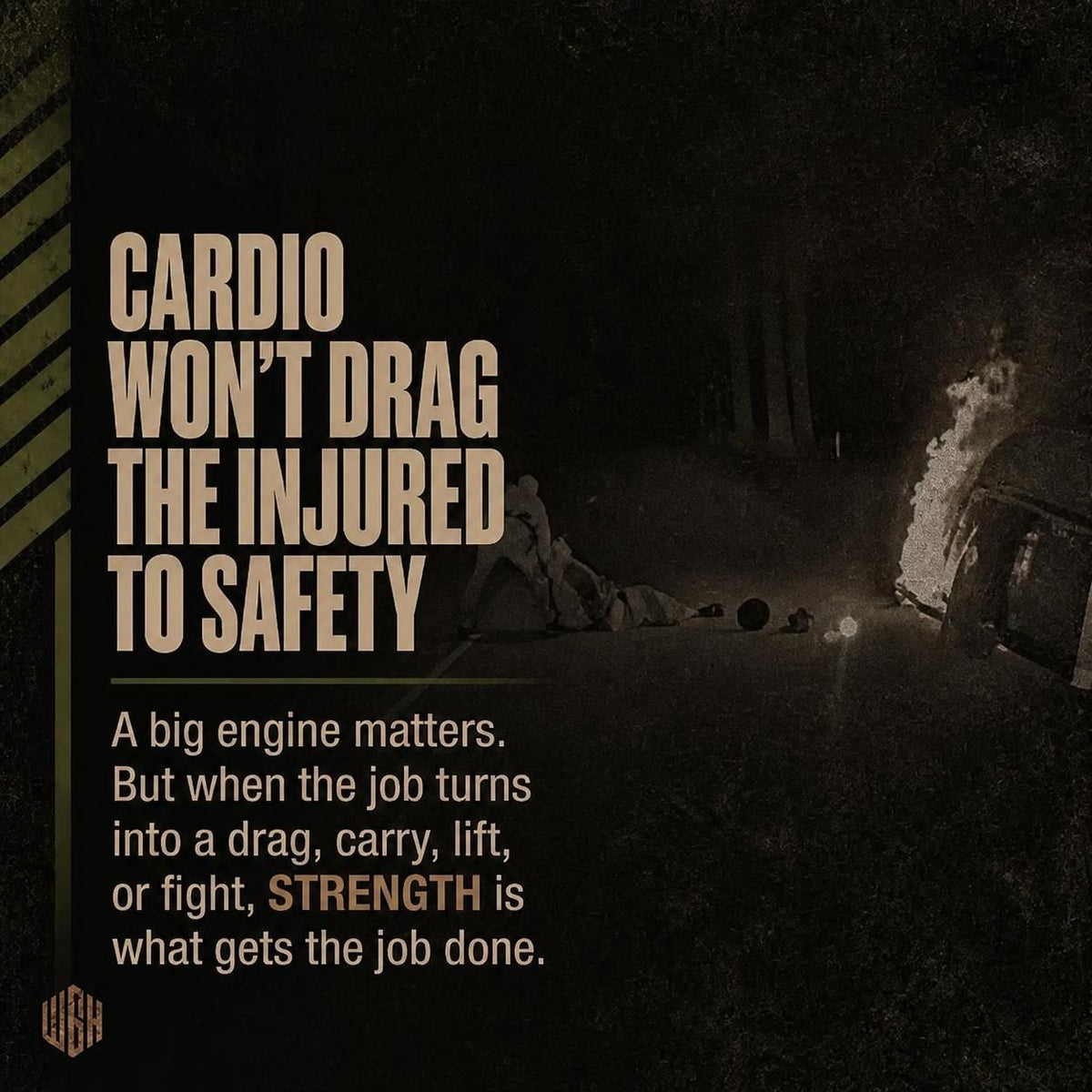

The Last Four Weeks of Our 12-Week Foundational Program: Maintaining Strength While We Push Aerobic Power
Build Real Strength and Capacity
The program we will discuss below is part of a 12-week cycle of programming we have used in the past. That cycle is divided into three four-week phases and is now available for individual, à la carte purchase.
While it is not the current Training Team cycle, it follows the same principles that guide all of our programming: sustainable training designed to build on itself over time. This approach is superior for overall performance in the tactical and first responder realm compared to the equivalent of a “crash diet” program that creates the illusion of progress by crushing you in every workout.
Our programming builds capacities—not just arbitrary numbers on specific exercises or times for certain run distances. The question is: What can you do when you’re not at your best, during that unknown event at that unknown time?
The testimonial below is from a user who is currently subscribed to current We Go Home live programming that runs year-round.
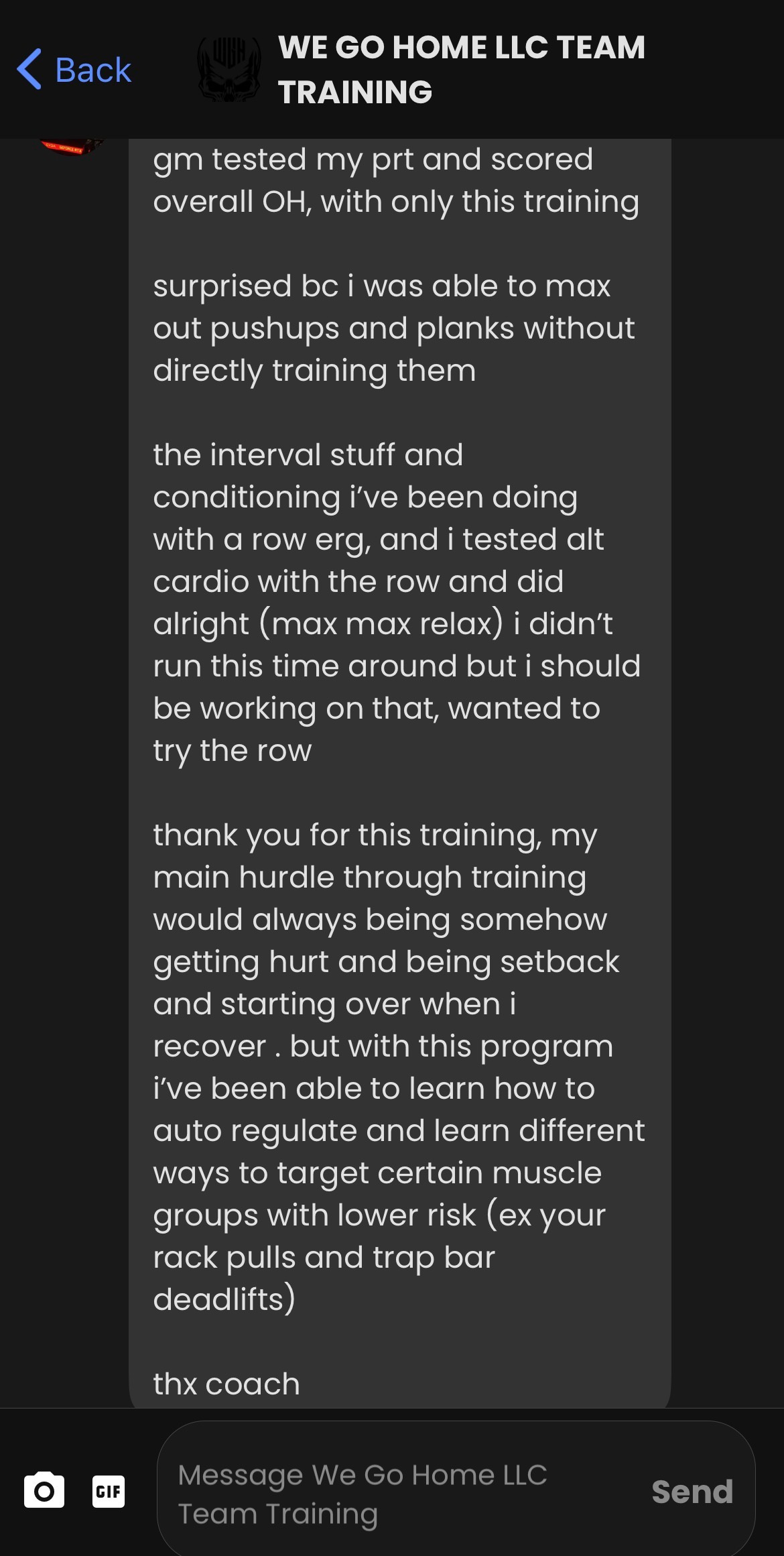
As you can read from the user above:
“GM tested my PRT and scored overall 0H, with only this training. Surprised because I was able to max out push-ups and planks without directly training them.”
Maxing out events without directly training them is always our goal. Of course, if you’re attending a selection course of some kind, we will train some of the events specifically to maximize performance.
However, in an ideal world, if you’re following a good program outside of your train-up, you shouldn’t have to specifically train those events for long—maybe just a few weeks of becoming familiar with the test movements.
The goal is not to assume that event-specific practice is unnecessary. The goal is to build such a broad base of strength, power, muscular endurance, and aerobic capacity that you are already prepared for the demands of the test before beginning a short period of specific preparation.
In this case, the user did not even have to do that.
The user also mentioned:
“My main hurdle through training would always be somehow getting hurt and being set back and starting over when I recover.”
I have gone through this myself, and it is a story I have heard too many times. You can’t train hard when you’re always healing. You’re not training hard if you’re always hurt.
This is where our programming system is different. I am often told by users that they found us after following programs that repeatedly left them injured.
The user continued:
“But with this program, I’ve been able to learn how to auto-regulate and learn different ways to target certain muscle groups with lower risk (e.g., your rack pulls and trap-bar deadlifts).”
We naturally rotate movements in our training to avoid the pitfall of overuse injuries, but we also advocate for choosing movements that fit you and where you are currently at.
If you can’t safely get into a good deadlift position from the floor, why would I want you to load that position? This is why I not only build multiple options into the program, but I am also just a message away if you need help selecting a substitution.
I am truly honored that people trust us with their strength and conditioning in the first responder, tactical, and private security fields. It is professionally satisfying to pass on lessons learned through more than 15 years of experience in this professional domain.
Below, we continue with our series by going over the last phase of our 12-week program.
Pushing the Limit
When heading to the police academy—or even when simply following sensible long-term programming—there can be a time and place to push ourselves with more intense methods.
In the last four weeks of our 12-week series, we do just that with our program: Aerobic Power—Into the Frontier.
Week 1 schedule below:
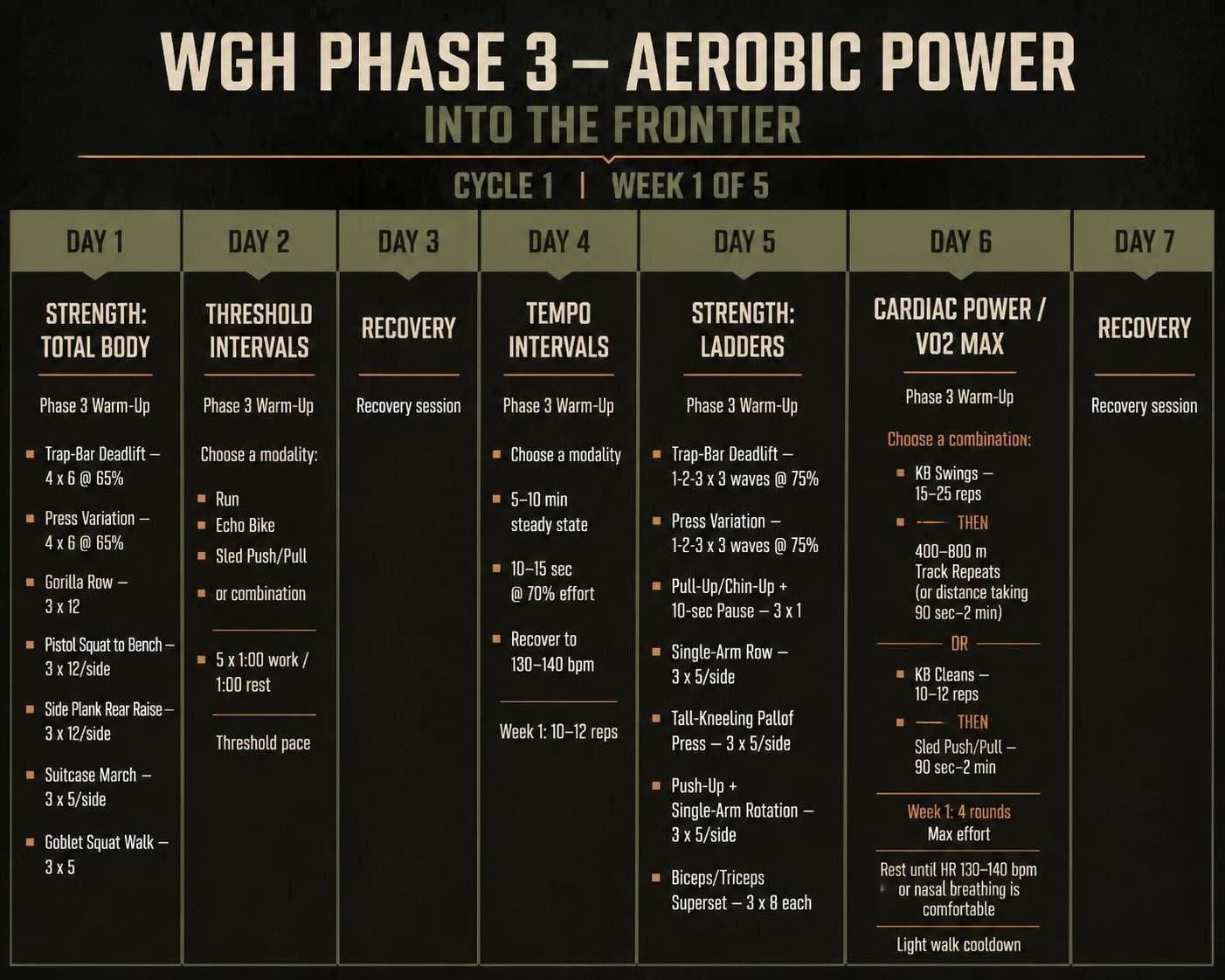
Yes, we push it during this phase. But the key is that we do so in a sensible manner that allows for recovery between sessions and ample room for performance on the job.
The only day of the week I recommend planning to complete well outside your shift—or even on an off day from work—is the Cardiac Power interval session on Day 6.
Goals of This Phase
-
Maintain or slightly build strength: Days 1 and 5
-
Increase threshold performance: Day 2
-
Increase aerobic power: Day 6
-
Maintain the aerobic base: Days 3 and 4
This means taking the eight weeks of hard training you just completed and putting on the afterburners.
Because you, as a disciplined professional, took the time to work within the somewhat stringent parameters of keeping most of your work in the aerobic base-building zones, you now get to reward yourself with some legitimate gut-check workouts.
The intent is not to turn every session into a test of willpower. The intent is to introduce higher-intensity work at the appropriate time, after a sufficient base has been established, while still maintaining enough structure and recovery to support performance on the job.
Closing
As I did with the other two phases, which are linked below, we will spend the next few weeks talking about the training days in detail and discussing the goals we are trying to achieve.
Again, I am honored that people who work in these fields trust me with their physical training.
Remember, physical training is only the base. You first need to root yourself in a deeper reason for why you’re in these professions. Ensure your “why” is legal, moral, and ethical.
Once your “why” is established, you will need to train—and train hard. Nobody is forcing you to do this. You need the skill sets to do these jobs properly. To develop those skill sets and perform, you need fitness. This is nonnegotiable.
Aimless, theatrically intense workouts will not achieve this over a 20-year career. Real performance is developed through relentless and tenacious consistency repeated for life.
If that doesn’t sound appealing, you may want to consider other fields.
Questions? Reach out.