

Part IV: Endurance (Anaerobic Threshold)
Key Takeaway
This article is going to cover one high(er) intensity method that we use in our SWAT and SOF selection programs. Unfortunately, this is usually where people start in their preparation.
I say unfortunately not because intensity or feeling like you’re working hard isn’t important for preparation. I say this because if trainees had the discipline to start with lower intensity aerobic based work (which doesn’t always mean “easy”) they would get more out of some of the methods we are going to discuss below.
Remember, the aerobic system is the engine and foundation of everything you do. Spending time building it will decrease the time needed for recovery between high(er) intensity sets/intervals.
In real-world application, during your selection you’ll recover between events faster. When you’re actually on the team you’ll have the gas tank to run up a flight of stairs and still be able to clear a room and function.
Intensity
Again, in all of programming where it is the:
We Go Home Human Performance Daily Training
We have built in progressions with a long term focus to reach your goals. This isn’t the crash diet version of workouts. We build you over time via proven methods that have worked to get people selected into SFAS and RASP. This why we call our yearly programming cycle BUILD.
Below, we are going to use Week 9 from our previous article to discuss the methods we introduce later in the training cycle from our Special Operations Program:
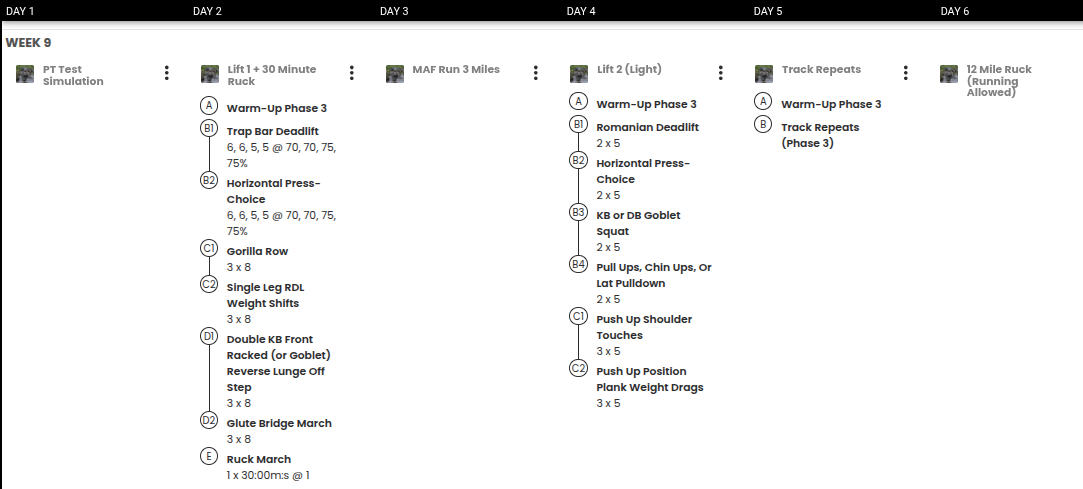
For week 9, we:
-
Dial back our lifts just a bit to maintain our strength.
-
Do a PT test simulation which often includes a max effort mid-distance run which means we will usually be training mostly our anaerobic threshold as this will be a sustained run for usually around 10-14 minutes.
-
Later in the week we do some some track repeats that ends up being a more of an aerobic focused day
-
Then end the week with an all out 12 miler like you would do at Ranger School or even some of the more intense law enforcement selections.
Although this is more of a “test” week, lets zoom out and look at the theme: Anaerobic threshold.
What does that mean? It means we are pushing ourselves right on the edge of where our anaerobic system starts to take over. For most, depending on training, that could be a heart rate as low as 160 but could creep up to 175 bpm.
Why is this important? Because the more you nudge up the point at which you flip to your anaerobic system, the longer you can maintain your activity and pace. The Aerobic system has the ability to power your activity for hours, while the anaerobic system does not.
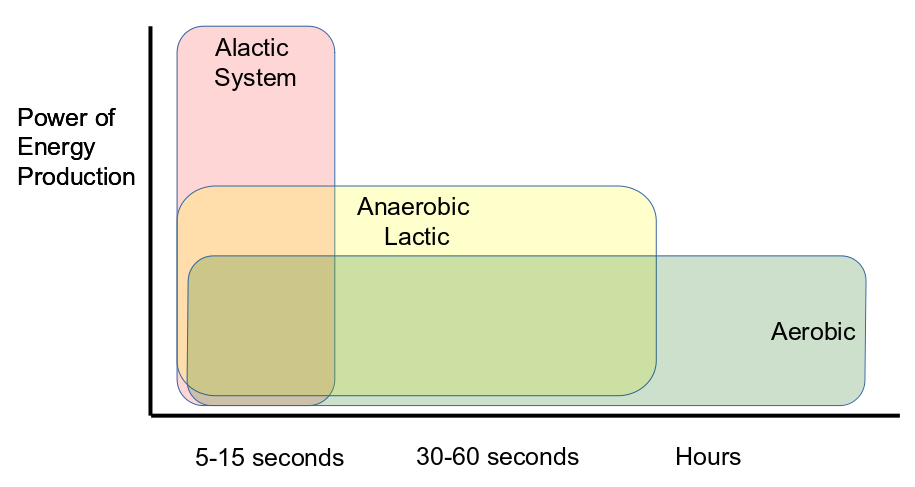
For example if in week one your anaerobic threshold is at 160bpm, once you drastically go over that heart rate you are now on a finite supply of energy. Your gas tank really starts to get drained, and you’re more likely to hit a wall as you try and cover more ground.
If you raise your anaerobic threshold to 165-170bpm, now you’ll be able to push yourself at harder intensities (usually faster speed) and cover more ground while using your aerobic system…again…an energy system that can go for hours.
Closing- How Do We Train This?
You train this by first starting with developing a massive aerobic engine. Lots of work, both loaded and unloaded, while keeping your heart rate between 115-150bpm.
After weeks of this, as there is no shortcut to these adaptations…you start to push down on the gas pedal a bit and raise your intensity into that 160-175bpm zone. This is where our threshold intervals come into play. Anywhere between 1-10 minute intervals followed by at least the same amount of time of active rest.
For rucking or kit runs we will have individuals push the pace, sometimes even just walking fast uphill, to achieve higher heart rate levels. Then once the duration of the interval is complete, have them walk at pace that keeps their heart rate between 115-150bpm during their “rest.”
This method is phenomenal for training both our anaerobic threshold and our aerobic capacity…ONCE AN AEROBIC BASE HAS BEEN ESTABLISHED.
Why do I emphasize this?
Because between those higher intensity intervals it is your aerobic system working to help you recover. If your aerobic system hasn’t been trained you’ll struggle to recover between intervals, and you’ll cover less ground and won’t be able to push yourself as hard during your threshold work. The session itself will even take more out of you and require more recovery.
This is why we structure our training in the way we do. Everything we do has a purpose and a reason behind it. If the program your following just simply crushes you every session then you’re not training. You’re just working out. This is a facade and more often than not will end in burnout or injury.
Which is not a recipe for success at a job interview that could change the trajectory of your career.