
Part III: Endurance (Aerobic Focused Energy System Development)
Key Takeaway
We covered strength training in our last article. In this one we will discuss endurance training and how we program it in our SWAT or SOF selection selection programs. The bottom line is that when time permits we always start our programming with developing an aerobic base, both with loaded and unloaded modalities.
As the program continues we then add on threshold training and other higher intensity methods to ensure peak performance during your event.
Endurance
Endurance training is not nearly a sideshow of our programming. We train it concurrently with strength training in our We Go Home Human Performance Daily Training, SWAT Selection program, and Special Operations Program. It should be part of any well rounded training program for Tactical and First Responders.
To discuss this topic, we will use the same programming samples from our Special Operations Program from our last article:
Week 1:
Week 9:
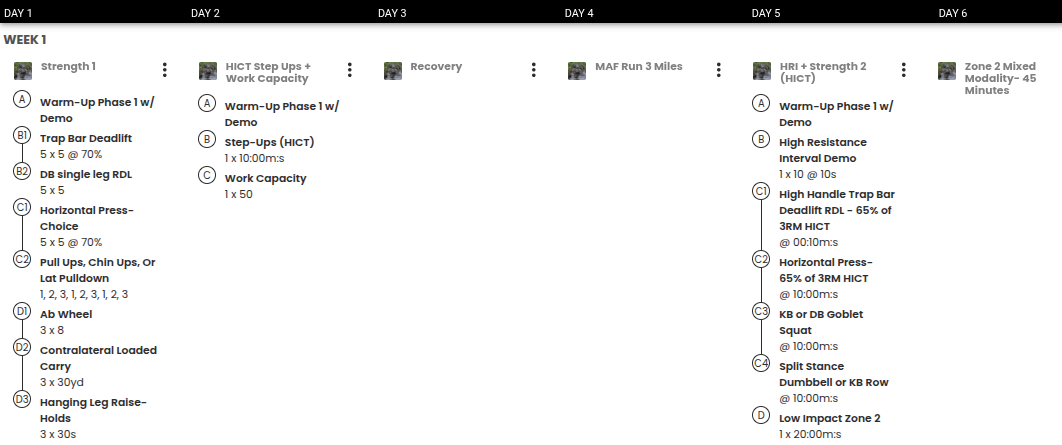
As you can see in week 1 we train hard, but our focus is foundational strength and Aerobic Capacity.
In Week 1 Day 2 we do High Intensity Continuous Training
Our method here is weighted step ups for timed sets. Each step should be forceful, and if you’re wearing a heart rate monitor your heart rate should not go above 155bpm. This way we train our ability to generate force while under fatigue while staying aerobic. We start light with these, holding 10-20lb dumbbells and then over the course of 16 weeks we get you up to a full ruck and holding weight in your hand. Sets range from 1 set of 10 minutes and then we build up to 1-2 sets of 20 minutes.
In Week 1 Day 4 we do a 3 mile MAF run
MAF is short for Dr. Maffetone. From a previous article both published on my substack and on We Go Home LLC we discuss this method in detail but here are the basics:
The Formula:
180 - Your Age = Target Heart Rate
Example: 30 Year Old
180 - 30 = 150 beats per minute (bpm)- Stay +/- 5 Bpm of this zone.
During your training session, stay within 145-155 bpm. If your heart rate goes above 155 bpm slow down or walk for a bit. If it is lower than 145 bpm, speed up (way less common at first). This could mean anywhere from 20-45 Minutes of constant motion at this intensity.
In this case you would run 3 miles while maintaining the intensity above.
In Week 1 Day 5 we do a High Resistance Interval Session and a High Intensity Continuous Training Circuit
First part of the session are short, 5-10 second intense intervals followed by full recovery, repeated 10 times. This could be a hill sprint, sled push, etc. Push a weighted sled for 10 seconds, wait for your heart rate to come down to 120-130 bpm, then repeat.
Then you move on to the lifting portion.
Light(er) weights moved as explosive as possible. Ideally you keep moving through the entire timed set. In week 1 that set is 10 minutes.
That means you’ll do 3-5 explosive reps of the following:
A1) Trap-bar deadlift x 3-5 Reps
A2) Bench press or weighted push up variation x 3-5 Reps
A3) Goblet Squat x 3-5 Reps
A4) Split Stance Row x 3-5 Reps each side
Move at a hard but sustainable pace. You shouldn’t be getting ready to pass out, but you should be moving through this briskly. If heart rate gets up to 160 bpm...slow down or take a short break.
In Week 1 Day 6 we do a long, Mixed Modality Zone 2 Session
45 minutes of mostly lower impact, cyclic modalities keeping your heart rate in the 130-150 bpm zone.
Closing
Now why is starting with our aerobic system crucial for programs like this?
Let’s reference the chart from page 52 from Cal Dietz’s excellent book, Triphasic Training.
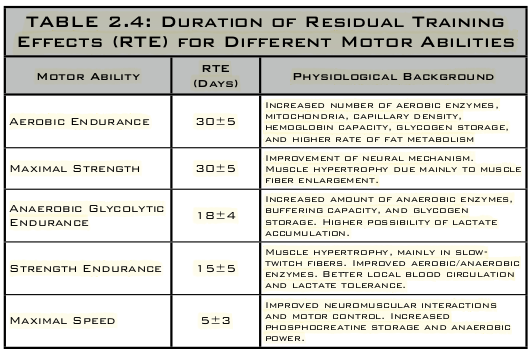
In short, notice what adaptation tends to stick around for a long time before losing it without any training...our aerobic endurance (Dietz 2012).
This means if we spend a long time developing this highly adaptable and foundational energy system, when we move to more intense methods there is less of a risk of losing these hard earned adaptations. Not only that, this will only enhance the harder interval training we do later because having a robust aerobic system will allow for faster recovery between intervals or harder bouts. This means you can push yourself even harder if you are patient and develop your aerobic system as opposed to jumping into the harder interval training first.
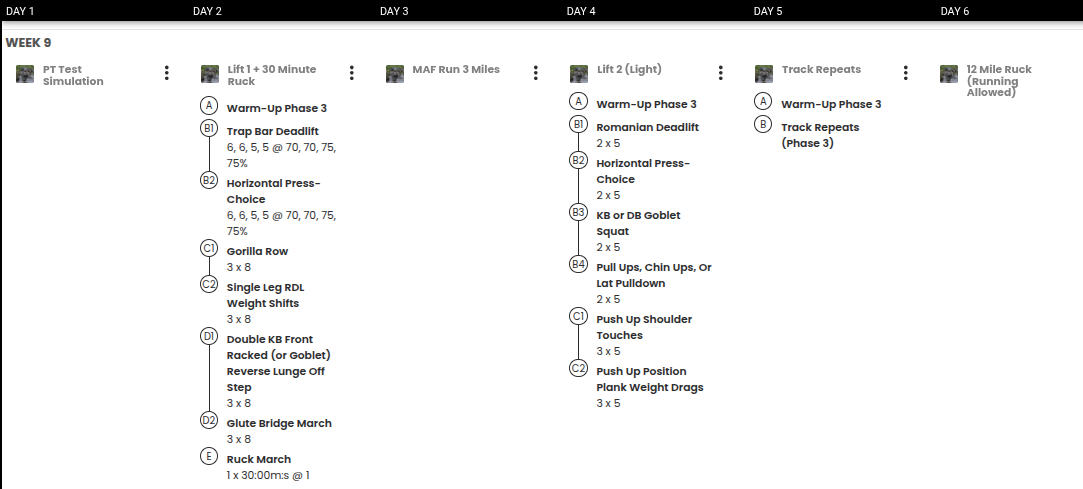
What are some of those more intense methods that we use down the road? We will cover them in our next article when we review week 9 from above.
Questions? Reach out or comment below.
References:
Dietz, C., & Peterson, B. (2012). Triphasic training: A systematic approach to elite speed and explosive strength performance. Bye Dietz Sport Enterprise.