

Strength Training Session Design
Key Takeaway
For Tactical Populations and First Responders it is important to understand that the strength and conditioning program you follow needs to fit where you are at in your life and career. Busy schedules, life stressors, shift work, and unpredictable hours make training quite challenging for these professions. For long term progress you will need to remain flexible with your training schedule and understand when it is time to push the intensity or dial it back.
This week we are going to talk about why a total body or upper/lower training split is usually the best for these populations.
Strength Sessions
In the We Go Home Human Performance Program I almost always use total body or Upper/Lower splits in our training. I do this for a few reasons…but growing up in the 90s I was told that the lifting week was:
Monday: Chest/Triceps
Tuesday: Back/Biceps
Wednesday: Off
Thursday: Shoulders/Traps
Friday: Legs
Now, maybe for a higher level bodybuilder this might be something that would work, but for athletics this isn’t optimal. And honestly for most people’s aesthetic goals this won’t get you where you want either. Most people want a muscular/fit look and splits like this simply don’t work as advertised.
Think about collegiate or professional athletes in various sports. I think most people would be quite happy with the muscularity of a football player or track and field athletes. Yet many are scared to train like them and still think “bodybuilding” is the way to go. Many people would not only look better, but also feel better on a more “athlete-style” focused program- First Responders are no different.
First Responder and Tactical Strength
For the First Responder, the other issue is your goals aren’t just aesthetic. You need to be able to build and display strength rapidly. You also need to be able to sprint, jump, and fight. Sometimes all in the same incident. Bodybuilding splits alone will not create the engine to do that.
Total body splits allows you the room in the week to get in other training sessions that are crucial for your success. This includes conditioning, self defense/combativeness, range time/stress shoots, and other dedicated conditioning sessions. You’re an athlete, and despite the muscularity you’ll see on many athletes they don’t just live in the gym. They’re running on a track, pulling sleds, or putting serious time in on the mat.
Example
In the last article we discussed the importance of the weekly structure and strategic placement of our high intensity training days. Below is a snip of one of our previous training weeks in the We Go Home Human Performance Program:
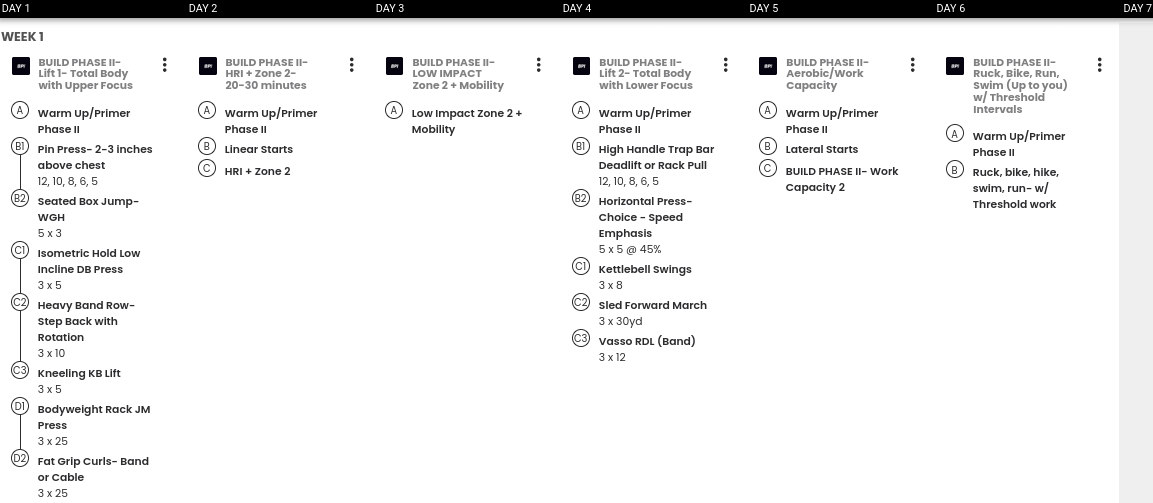
Notice for this phase we do two dedicated strength sessions a week, both are total body, but we emphasize either the upper or lower body for the heavy effort lift of the day. If it is a heavy upper day, we complement it with a lower body explosive lift or jump. The opposite is true for the second session.
The rest of the training session are higher rep assistance work for whatever the main lift was for the day. As you can see, we still “body-build” in a sense but usually after our main lifts and power work. Building muscle is important for First Responders, just not at the expense of conditioning or other qualities. This will also help build other connective tissues in the body to keep you not only looking good but feeling good as well.
The next article will talk conditioning, but you can see on days 2 and 5 we have some movement training, sprint variations, and work capacity circuits. We will discuss more later and I’ll provide details but my point is that yes, we only do two true strength sessions a week with heavy compound lifts…but that doesn’t mean you won’t still lift some weight on the other days of the week.
Closing
Remember, truly hard training sessions will require anywhere between 48-72 hours for recovery (Simmons, 2015). I try not to get to the point where you need a full 72 hours for recovery because you aren’t dedicated sport athletes or powerlifters. You need to be able to operate at a high level in your professions and if you can’t move the day or two after a strength session you’re useless to your community, your team, and yourself.
With that said I still structure the week so that your conditioning complements your strength work, and your high(er) intensity days have a couple days in between them. You never know when you’re going to get that structure fire call or the driver is going to bolt from your traffic stop.
With proper program structure you can train hard and still have high personal readiness. It just requires a little planning, dialed in nutrition, and consistency.
Questions? Reach out or comment.
References
Simmons, L. (2015). Special strength development for all sports. Westside Barbell.