

After you build the base, this is where you take your performance to the next level.
Don’t Be Afraid to Be a Novice Again
Throughout my career and training, I have had to start over multiple times: strength coach intern, graduate assistant, new cop, Army enlistee, and eventually the new guy at Ranger Regiment.
Looking back, during all of those transitional periods, I wanted to rush to the end and become “qualified” in whatever that new role was.
The reality is that everything takes time and experience. Everyone may start from a different point, but we can all benefit from taking a breath and becoming the “new guy” again.
The same applies to training.
In this article, I’ll discuss higher-intensity conditioning methods. If you jump into these methods without first building the appropriate foundation, you’ll shortchange your long-term adaptations.
Even if you are already fit, there is nothing wrong with scaling back for a while and using earlier phases to address gaps.
Energy System Development: “Into the Frontier” Phase
Reference Training Week 1 below. In this article, we will focus on Days 2, 4, and 6. The strength work was covered in the last article.
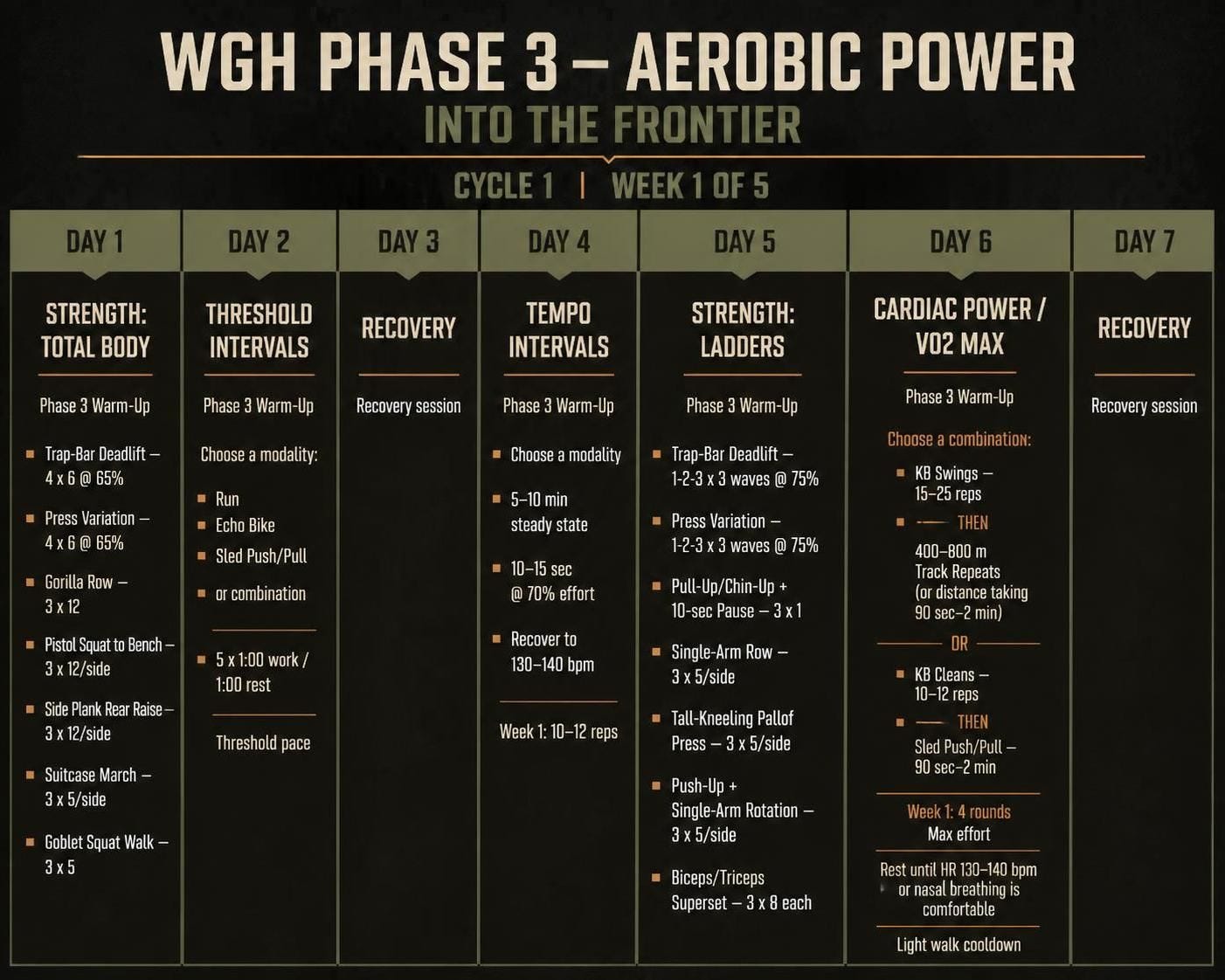
Day 2: Threshold Intervals
We are going to continue with the threshold work from the last phase, but reduce the volume slightly. I prefer mixed-modality work, like what you see in the schedule above.
Week 1 prescription:
-
1 minute of work
-
1 minute of active recovery
-
5 total rounds
-
1:1 work-to-rest ratio
-
Threshold effort throughout each work interval
Build to an effort that brings your heart rate to approximately 160–170 beats per minute, depending on the individual. Use effort and pace as your primary guides, since heart rate can lag during short intervals and will vary between athletes.
The goal is to maintain a consistent effort across all five rounds—not sprint the first interval and survive the rest.
Day 4: Tempo Intervals
This should be viewed as another aerobic training day that helps support recovery before the harder workouts later in the week.
Modality:
-
Choose one modality for the session.
-
Good options include the bike, sled, medicine-ball throws, or another activity that is not primarily dependent on eccentric muscle contractions.
-
The goal is to create a repeatable training stimulus without causing excessive soreness or muscle damage.
Prescription:
-
Begin with 5–10 minutes of steady-state work.
-
Perform 10–15 seconds of work at approximately 70% effort.
-
Recover fully before beginning the next repetition.
-
Week 1: 10–12 repetitions
Recovery:
Full recovery should fall within the following range:
-
Heart rate returns to approximately 130–140 bpm
-
You can breathe exclusively through your nose
If you are using a heart-rate monitor, begin the next repetition once your heart rate has returned to the prescribed range. If you do not have a monitor, use nasal breathing as your guide.
Athletes with a high level of fitness may be able to perform these intervals every minute on the minute, but only if they can meet the recovery standards above.
Day 6: Cardiac Power / VO₂ Max Intervals
Due to your discipline and effort over the past two months, you now get to push yourself into the frontier of your aerobic system.
The goal of VO₂ max, or cardiac power, intervals is to push your cardiovascular system toward its upper limits and sustain a high level of effort for a prescribed period of time.
Modality:
Use a total-body conditioning method or a combination of several modalities. Possible options include:
-
Sprints
-
Long, steep incline efforts
-
Echo Bike
-
Assault Bike
-
Kettlebell complexes
-
Sled pushes or pulls
-
Heavy bag or pad work
-
Grappling
If you are like me and require most of your conditioning to be lower impact, I suggest using the Echo Bike, Assault Bike, kettlebell complexes, or the sled if you have enough space to push or pull it.
Hitting the heavy bag or pads can work here as well. Just understand that this is a highly fatiguing conditioning tool. As you become tired, your technique may suffer, which can reinforce poor movement habits.
Recovery:
-
Complete the prescribed work interval.
-
Rest until your heart rate returns to approximately 130–140 bpm.
-
If you do not have a heart-rate monitor, recover until you can comfortably breathe through your nose.
-
Repeat once you have met one of those recovery standards.
I strongly recommend using a heart-rate monitor for this session.
The volume will look low, but each work interval is intended to be a maximal or near-maximal effort. This is not a session to rush through.
Example combinations:
-
Kettlebell swings: 15–25 repetitions
Immediately followed by a 400–800-meter track repeat, or whatever distance allows you to work for 90 seconds to 2 minutes. -
Kettlebell cleans: 10–12 repetitions
Immediately followed by a sled push or pull for 90 seconds to 2 minutes. -
Goblet squats or double-kettlebell front squats: 10–12 repetitions
Immediately followed by the Assault Bike or Echo Bike for 90 seconds to 2 minutes. -
Kettlebell thrusters: 10–12 repetitions
Immediately followed by heavy bag work for 90 seconds to 2 minutes. -
Single-arm kettlebell clean and press: 5 right and 5 left
Immediately followed by max-effort grappling for 90-second to 2-minute rounds. Your partner should be relentless.
These are just examples. You can use variations of these combinations or choose a different combination for each set.
Choose your own adventure.
Operational considerations:
-
Schedule this session with plenty of time between training and your shift.
-
Do not complete this workout and immediately change into your uniform to go protect the public and save lives.
-
Perform it on a day when your schedule allows enough time to determine how much recovery you need before your duties begin.
Progression for this block:
-
Week 1: 4 repetitions
-
Work interval: 90 seconds per repetition
-
Recovery: Rest until your heart rate returns to 130–140 bpm, or until you can comfortably breathe through your nose.
The volume will progress throughout the month. By the end of the block, you will work up to 8 repetitions of 2 minutes each, with recovery between intervals dictated by your heart rate and breathing.
Closing
As you can see, there is a reason we only have two strength-training days each week. This conditioning work is no joke. It is designed to push you after you have spent the previous phases building a substantial strength and aerobic base.
This is where you really push your limits so that, if things go south on the street, you have a significant fitness reserve to handle the situation.
Of course, you cannot train this way forever. Despite what certain programs may tell you, this level of intensity will eventually catch up with you and lead to burnout.
The goal is to push for four weeks, improve your VO₂ max, increase your threshold capacity, and potentially nudge your strength forward as well.
To do that, you need to follow a program—not just apply random intensity.
Questions? Reach out.