
Part of our 12-week first responder training series: how we build usable strength without sacrificing conditioning
True Functional Strength
If you’re thinking about becoming a police officer or firefighter, go on YouTube and search for “police officer saves individual from burning vehicle” or any hand-to-hand grappling fight that often happens when police officers deal with a resisting suspect. Firefighters can be seen dragging and carrying individuals to safety, often in awkward positions and tight spaces.
These are real-world examples of where a first responder may need to display strength under load. In those moments, it might not matter if you’re a devoted marathon runner who smoked everyone in the academy on the PT test. If you fold under load, that giant aerobic engine you’ve built won’t matter much for the job you signed up to do.
As I’ve said throughout these articles, performance in the first responder realm requires balance. This article explains how we continue developing strength in this program even as we raise the bar in conditioning, as discussed in our previous articles about one of our training blocks, On the Brink.
What Strength Training Is Not
Many training systems use the term “functional fitness” to describe their programming. Usually, this means lots of barbell complexes and endless circuits that will certainly fatigue you, but often don’t offer much long-term progression once you’re past a very novice level. That assumes you aren’t injured before you get there, as these circuits are often packed with high-rep Olympic lifts and other poor exercise selections.
What is truly functional is increasing strength and conditioning in a safe manner with long-term progression. Although there can be some overlap, endurance and strength adaptations can compete with one another if training volume, intensity, and recovery are not managed well.
This is where real training matters, as opposed to loading up a bar and just smoking someone. Just because you’re holding weights in your hand doesn’t mean you’re building strength any more than picking an arbitrary distance and running will build endurance. If your goal is to improve top-end speed, you’ll need to sprint. If your goal is to get stronger, you’ll generally need to lift heavier weights over time.
Rep Ranges
There are many ways to get stronger depending on your experience, and there are also many ways to explain it. I like how the late Louie Simmons of Westside Barbell would explain it, usually while referencing Supertraining and other Soviet sports science.
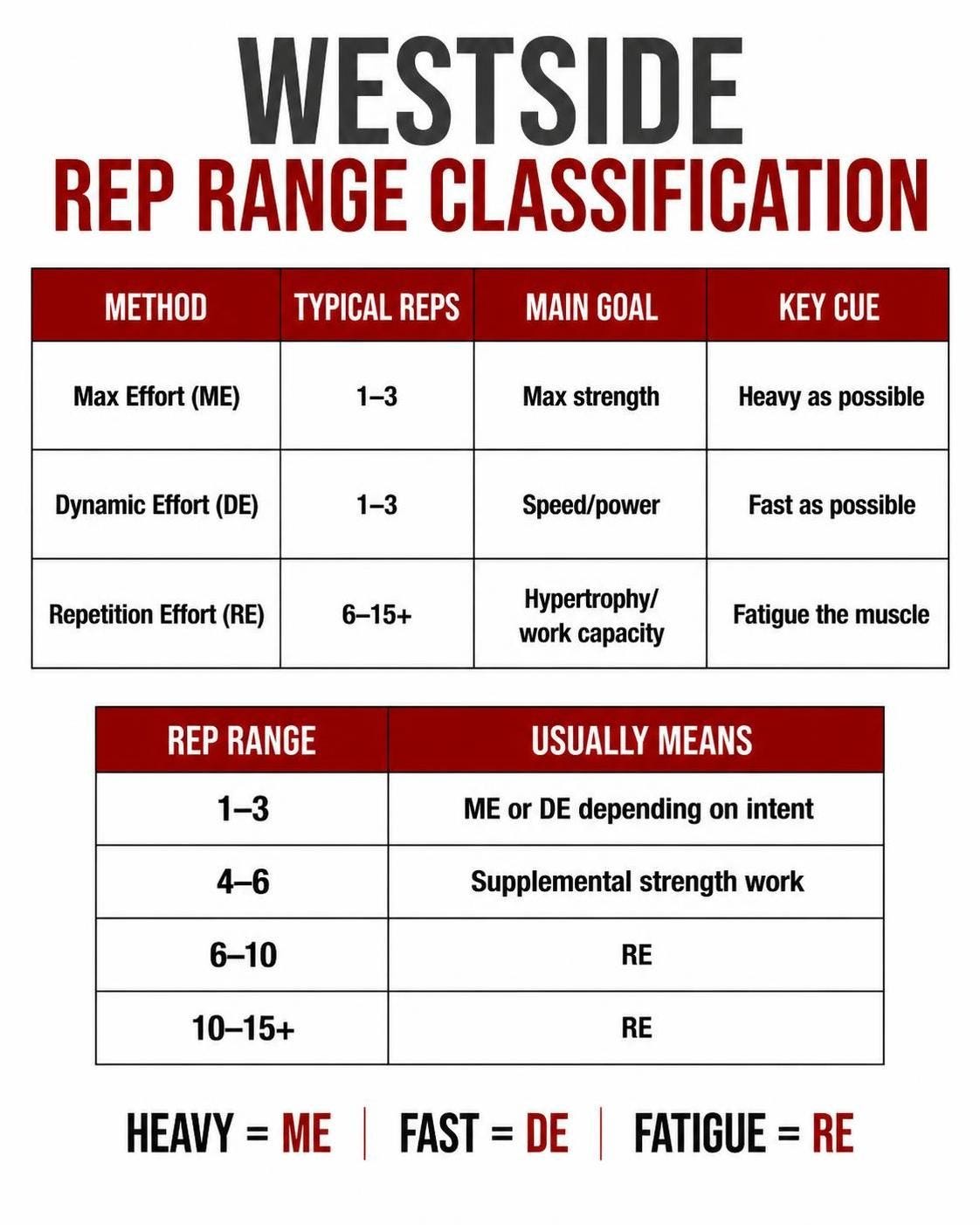
In application, I usually keep the rep range for strength work in our programming at around 4–7 reps. For this population and this phase of training, that tends to be a practical sweet spot for neurological adaptation while also building some muscle. It also gives older trainees more room for good and bad days, plus some wiggle room to fit in more conditioning. Remember, you’re not powerlifters. We have to train a lot of qualities, and particularly in this phase, where we are working in more threshold training, we don’t want to overload you with too much intensity.
For our accessory work, we use the repetition method to build muscle and volume where it is needed to support the big lifts. This not only brings up weaknesses, but also raises your overall work capacity so you can handle harder training sessions later.
We also use a form of dynamic effort training on our HICT circuit day. HICT here refers to a higher-intensity continuous circuit: moving lighter weights as fast as possible while building some systemic fatigue and keeping the heart rate in an aerobic range for a programmed period of time. This borrows the intent of speed work, but applies it in a way that better fits the needs of first responders and tactical populations.
Below is the schedule we have been referencing from our Program On The Brink in this series:
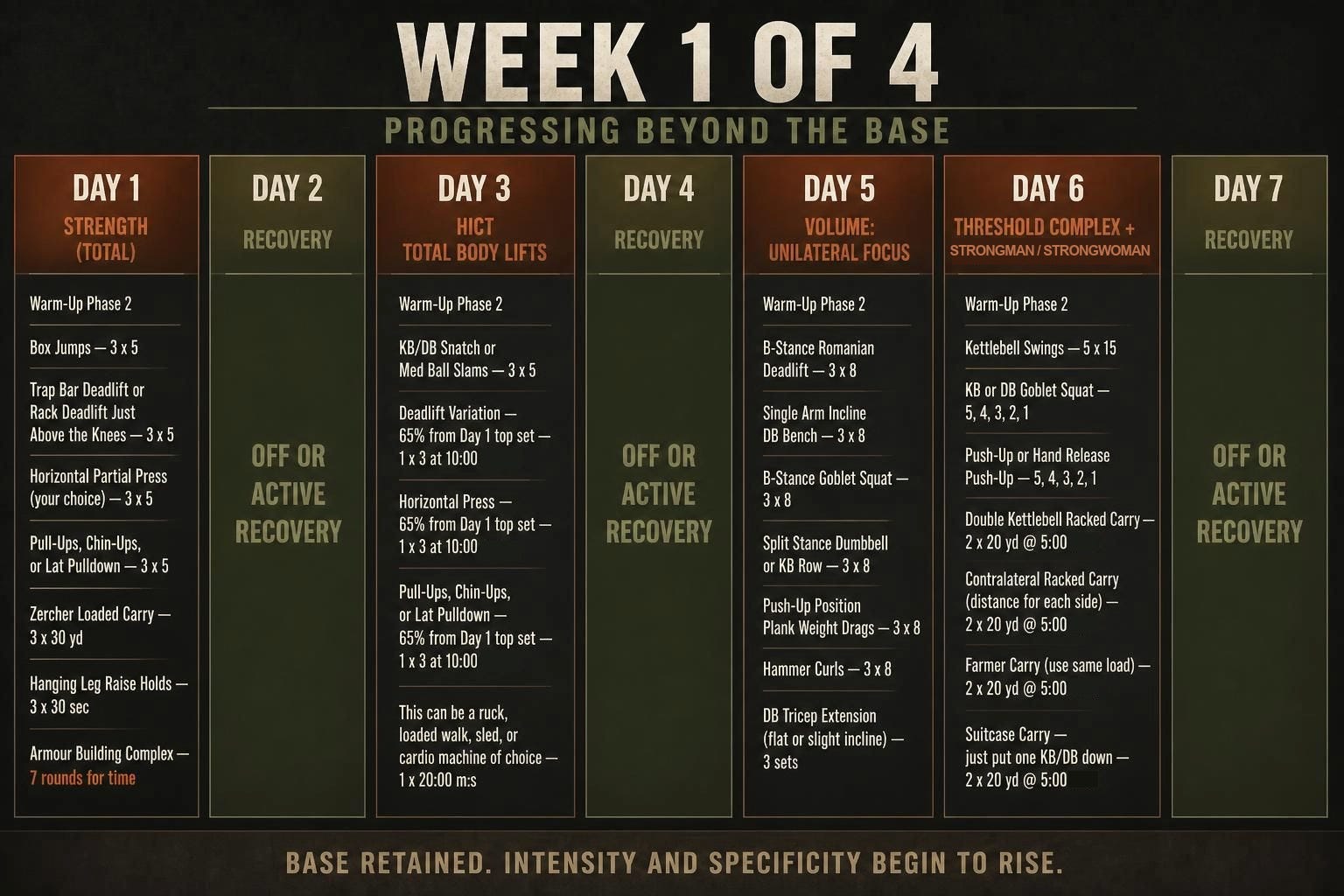
Day 1- Total Strength
We warm up, do a few jumps to wake up the nervous system, and then hit some big lifts. You can do these as a slow strength circuit or build to a heavy set of five on each movement. That means you would load a light weight, do 5 reps, rest, add some weight, rest, and continue until you find a weight that allows you to lift 4–7 hard reps for your work set. As you get closer to that weight, rest 2–3 minutes between sets. But it shouldn’t take you all day.
Follow that with carries, higher-repetition accessory work, and a complex.
Why: This is the day where we train in the heavier rep range that drives absolute strength gains. We are training the nervous system, muscle, and connective tissues to handle heavier loads.
Day 3: HICT
This is a variation on Westside-style speed work. I like to program this for first responders and tactical populations because it also works in a form of higher-end aerobic training while focusing on maintaining explosive power as fatigue builds. Think of it as being able to display power while tired.
You’ll base the 65% off Day 1’s final heavy set for each movement. If you trap-bar deadlifted 405 x 5, you would use about 260–265 for this session. Move it as fast as possible for 3 reps at a time during this circuit for a total of 10 minutes. Slow down if rep speed drops substantially or you really start to redline your heart rate.
Why: Strength displayed quickly is where performance lives. Although developing strength certainly helps you move lighter loads fast, getting trainees to learn how to brace and then move explosively is another skill. Adding fatigue management and learning how to recover efficiently between efforts is another skill that helps performance on the street.
Day 4: Volume
This is a classic repetition, or bodybuilding, rep range. The twist here is that we focus on unilateral movements.
Why: This gives your nervous system a break from the heavier weights in the previous two sessions and hopefully irons out any serious imbalances between each side of the body. Some people are surprised to see how much discrepancy can exist between limbs, which can often be improved just through practicing the movements and letting the body figure it out. This should also help with injury prevention.
Closing
Strength, like an aerobic foundation, is crucial for performance. This is simply how we develop it in this phase of the program. Of course, this doesn’t address proper training in takedowns, boxing, BJJ, tactics, and so on. However, strength supports all of these things. The stronger you are, the easier it becomes to move under load. Almost all of these jobs require body armor, full kit, oxygen tanks, or other equipment. Combined with the conditioning of this phase, this approach helps cover the major physical demands you’re likely to face.
The next article will go into the third and final phase of our 12-week programming cycle. This is where we really push things, but we do it responsibly so you can still perform when it counts.
Questions? Reach out.