
How to build the conditioning the Police or Fire academy demands (and the job actually requires)
1.5-Mile Run
I was recently talking with a former coworker about his experience at the police academy. He remembers an all-too-common trend: some of his classmates signed up to be police officers but didn’t have the basic level of fitness to run 1.5 miles unbroken. Not break any records—just keep moving until they’d covered the distance for the academy’s physical fitness assessment.
Now, the typical push-ups, sit-ups, 1.5-mile run isn’t the be-all and end-all of fitness testing. Plenty of agencies have moved toward more balanced assessments that fold in strength and other metrics. But despite the shortcomings of this dated test, I’d argue the average police officer, SWAT operator, or firefighter should be able to pass it even when they’re not at their best—running on limited sleep, underfed, or just plain fatigued. You should be able to roll out of bed and achieve at least the minimum standard. That holds true even if you’re not a dedicated runner.
This should be obvious, but at the academy you should strive to excel at whatever’s put in front of you, and this test is no exception. On top of that, the early weeks tend to come with the standard smoke sessions and instructors yelling at you. A large aerobic base helps you recover between those “character-building” sessions while your less-prepared classmates keep digging themselves deeper into recovery debt and stress.
This article lays out a framework for building the kind of general endurance that will more than prepare you to pass a basic academy test—and then some. Since each training day has its own goals and methods, we’ll cover the three sessions across three separate articles. We’ll start here with Day 1.
Notes
This blueprint is designed to run concurrently with the strength plan from the previous article. In my opinion, conditioning sessions need a bit more explanation when you’re actually training—as opposed to just trying to make yourself tired—so we’ll break down each day on its own.
First responders aren’t pure endurance or strength athletes. This program is built to develop well-rounded fitness. Think combat athlete, or a skill-position player in football, rather than a marathon runner. You’ll look more fit and be stronger than the guy at your commercial gym who calls himself a “bodybuilder.”
I’m not a doctor, so this isn’t medical advice—but if you’ve got some wear and tear, or you’re getting into this later in life, a lot of people do better with a “quality over quantity” approach to running volume. That means running just enough to test well and then developing the rest of your conditioning through other modalities (sled, kettlebells, bike, and so on).
That said, plenty of academies will have you doing long runs—it’s just part of the culture. If that’s your situation, build yourself up so you can tolerate it, even if it’s not something you carry through the rest of your career.
And I know the old adage is to just run every day to get ready for something like this. Please don’t. That might work when you’re 18, but even then I’d argue you’ll plateau and probably pick up an overuse injury along the way. Take the slightly longer path with a balanced approach, like the one below.
Program
I’m borrowing from the framework we used in the original We Go Home program that launched on TrainHeroic over a year ago. We cycle through different programs for our Training Team, but this one stays popular—and it’s called The Foundation for a reason: we’re laying the groundwork for the more intense conditioning in later blocks. The assumption here is that you’re easing back into running and looking to build your aerobic engine. Below is the the layout for the first training week, and I highlighted the training day we’re looking at today:
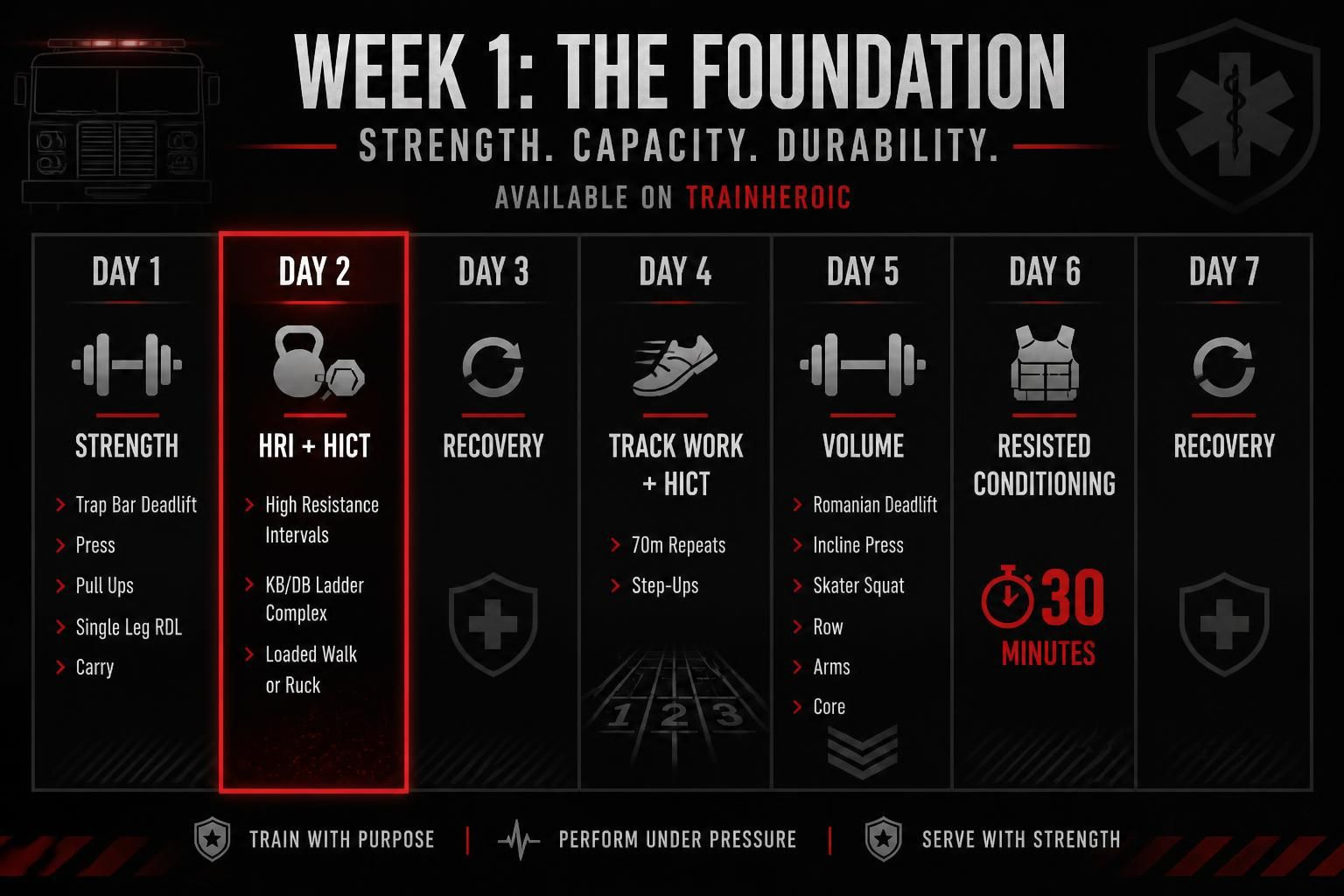
Day 1 Conditioning (After Your First Strength Day, Day 2 For The week)
This is one of three training days in the week. The order matters. After a proper warm-up, you’ll move from short, explosive efforts, to sustained loaded cardio, and finish with a loaded walk. That progression lets you express real power while you’re fresh, build conditioning under load while you’ve still got something in the tank, and finish with movement under load—a low-impact way to build time on your feet without beating up your joints. Grab a heart rate monitor; you’ll use it throughout.
Warm-Up
Foam roll for about 5 minutes, hitting the whole body but paying particular attention to the lats, pecs, and glutes. Don’t get aggressive with it—we’re just trying to calm the nervous system down and move a little better. Then complete the following as a circuit for two rounds:
-
Stationary Bear Crawl (hold position) — 20 seconds
-
Forward and Backward Bear Crawl — 10 yards
-
Active Isolated Hamstring Stretch — 8 each
-
Quad Rock w/ Reach — 8 each
-
Bird Dogs (slow and deliberate) — 8 each
-
Side-Lying Clam (add a band around the knees if too easy) — 8 each
-
Glute Bridge — 8 each
-
Single-Leg Load and Lift (use support if needed; add light load or a band if too easy) — 8 each
-
World’s Greatest Stretch — 10 yards
Block 1: High Resistance Intervals (HRI)
With the warm-up done, we start with high resistance intervals. The idea is simple: short, explosive efforts of roughly 5–15 seconds against a fair amount of resistance, followed by full recovery, then repeated. “Full recovery” means letting your heart rate settle back to 130–140 bpm before you go again. The resistance is only there during the work interval; you remove it (or coast) during recovery. That’s what keeps each effort explosive instead of turning the whole thing into a grind.
Pick one modality per session. Any of these work:
-
KB swings (8–12 reps)
-
Assault bike
-
Echo bike
-
Spin bike
-
Moderately loaded sled
-
Hill sprints
Build volume across the block by adding intervals week to week:
-
Week 1: 5 intervals
-
Week 2: 7 intervals
-
Week 3: 9 intervals
-
Week 4: 7 intervals (deload)
Block 2: KB Ladder Complex
Once you’ve finished the HRI work and caught your breath, move into the kettlebell ladder complex. Where the first block was all about short, explosive efforts with full recovery, this is loaded cardio. You’ll keep moving continuously for the allotted time at a hard but sustainable pace, not the all-out intervals that require recovery between bouts.
The complex is one continuous ladder using the same pair of kettlebells throughout:
-
Double KB Clean
-
Double KB Press
-
Double KB Front Squat
-
Renegade Row (each arm)
You’ll climb a rep ladder. Start with 1 rep of each movement in order, then go back to the top for 2 reps of each, then 3 of each—then come back down to 1 and repeat the pattern for the programmed time. So one full cycle looks like this:
Round of 1
-
Double KB Clean: 1
-
Double KB Press: 1
-
Double KB Front Squat: 1
-
Renegade Row: 1 (each arm)
Round of 2
-
Double KB Clean: 2
-
Double KB Press: 2
-
Double KB Front Squat: 2
-
Renegade Row: 2 (each arm)
Round of 3
-
Double KB Clean: 3
-
Double KB Press: 3
-
Double KB Front Squat: 3
-
Renegade Row: 3 (each arm)
Then back to 1 and repeat: 1, 2, 3, 1, 2, 3, and so on until time is up.
The whole point is to keep moving while keeping movement quality high. Aim for a heart rate around 150–160 bpm. If you need to slow down to stay there, slow down—this is a pace you should be able to sustain, not a sprint you’re trying to survive. Build duration across the block:
-
Week 1: 10 minutes
-
Week 2: 12 minutes
-
Week 3: 15 minutes
-
Week 4: 12 minutes (deload)
Block 3: Ruck March (Loaded Walk)
The last block of the day is the simplest to describe and the easiest to get wrong. Put on a load comparable to your professional duties and step it out. For most people that means rucking with a pack; if you’re police, a weight vest works; if you’re fire, use a duty-equivalent load. The point is to train your body to carry weight over distance—exactly what the job asks of you.
Keep your heart rate between 120 and 150 bpm for the prescribed time. This is a walk with a purpose—not a stroll, not a race. You’re moving with intent, but you should never be gassed.
One hard rule for this phase: do not run under load. The goal is to build your ability to carry weight, not to beat up your joints or turn this into another conditioning grinder. Save the running for when you’re unloaded - for now.
Final Thoughts
Again, the focus of this day—and the whole block—is building your aerobic base. One caution: I’m sure you’re motivated if you’re reading this, but don’t disregard the heart rate and intensity zones. Even if you’re fit, most people never actually spend time building their aerobic system, and blowing past these zones just short-changes you over the long haul.
You’re also going to have to do some honest self-assessment. I know you want to get better at running, but the right progression for your HRI work right now might be to start with the bike one week, the sled the next, hill sprints after that, and then maybe some 90%-effort sprint work. The last thing you want is to pull a hamstring because you didn’t take the time to prep your body for the truly violent motion that sprinting is.
Take your time. Let the program do its work. Next week, we’ll cover conditioning day 2.
Questions? Reach out.