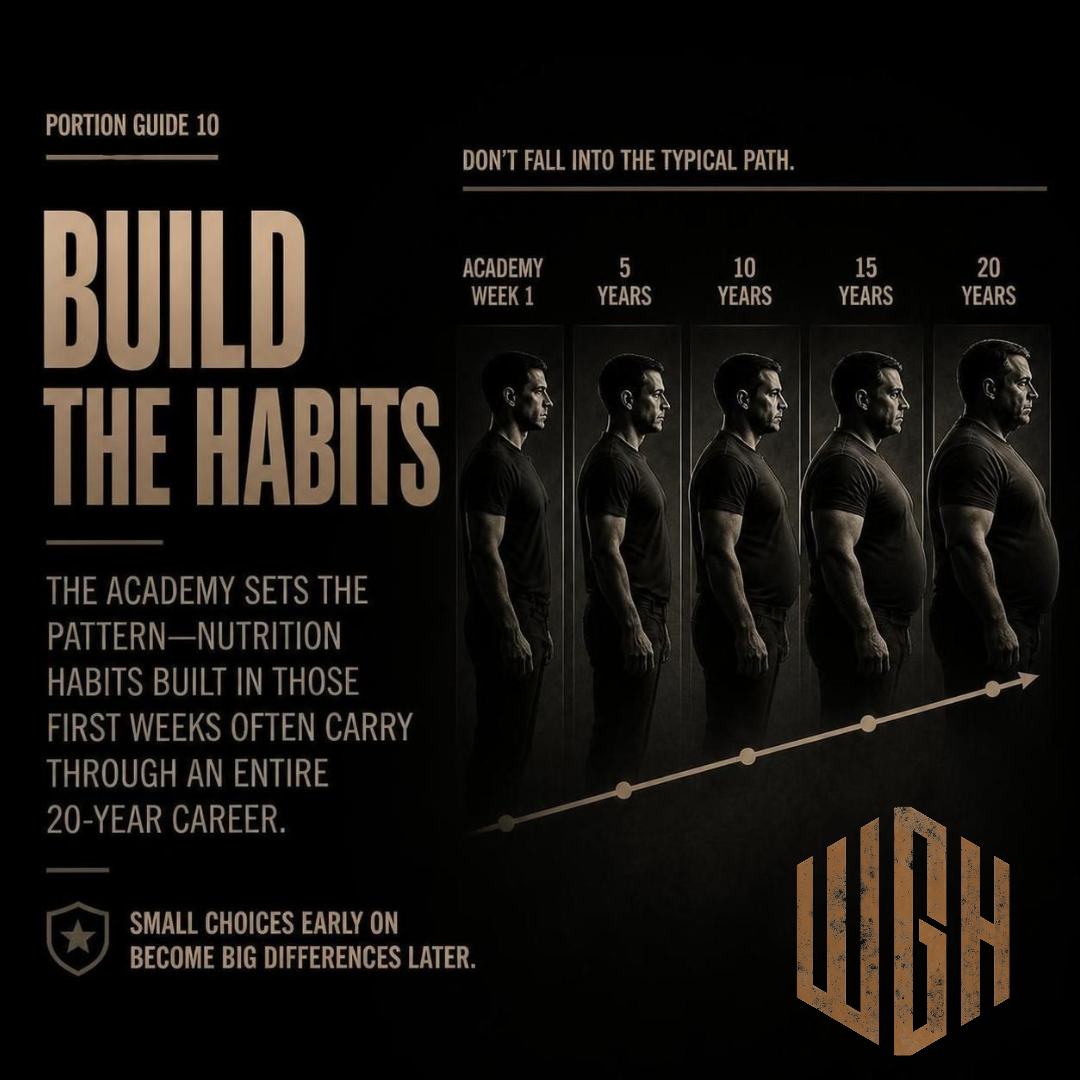

The academy is where you set the tone for your career trajectory. Don't let mediocre peers lower the bar for you.
First Shift
After months at the police academy, I’ll never forget my first shift meeting.
Walking in from the garage, I noticed officers smoking—something I understood but hadn’t seen in my previous life as a graduate assistant strength coach at a Division I university. Not a single person smoked in that athletic department, not athletes or staff.
I was one of the first in the briefing room when a disheveled officer walked in, still adjusting his uniform. He was severely overweight—his flashlight hung almost perpendicular to his body, pushed outward by his stomach.
I remember thinking: This job has serious physical demands. How does someone work here in that condition?
As the rest of the shift filtered in, I noticed a pattern. Not everyone was in that shape, but the overall physical standard was striking. A gap I hadn’t anticipated.
What did I get myself into?
Culture Sets the Floor—You Set Your Ceiling
It’s been nearly two decades, and I still remember that moment because it taught me something crucial: organizations set minimum standards, but individuals choose whether to meet them or exceed them.
After leaving that department, I enlisted in the Army and completed RASP (Ranger Assessment and Selection Program) to serve in the 75th Ranger Regiment. That’s where I truly understood the difference between an organization that enforces a standard and one that merely allows it.
Ranger Regiment had a different culture. You passed RASP. If you wanted to stay, you graduated Ranger School. Two gates. The minimum standard was the actual minimum. Then came the daily reality: your job performance, physical fitness, body composition—an endless interview to remain.
That officer from my first shift? His struggle didn’t start on day one of the job. It started at the academy, in a moment of choice he probably doesn’t remember.
The Academy is Where Trajectories Fork
When I think back to my police academy class, I see two paths:
The Bare Minimum Path:
-
“I’ll get in shape when I’m at the academy.”
-
“I could clean up my diet a bit.”
-
“I just need to pass the Cooper standard.”
The Standard-Setting Path:
-
“I’m showing up in the best shape of my life.”
-
“I’m packing protein shakes—I don’t care if my peers look at me weird.”
-
“I’m going to look the part, be the part, and set the tone for my entire career.”
One of these choices compounds over 20 years. The other doesn’t.
The majority of your academy class will choose the first path. That’s fine for them. But your choice at the academy will determine what kind of officer you become—not just physically, but in how the job sees you.
Physical Presence is a Silent Resume
Instructors set the example and enforce standards. But here’s the truth: it comes down to you.
You’re building a walking resume. When you pull over someone at 2 a.m. who’s “known to be armed and assault officers,” that person reads your presence in seconds. Your posture. Your movement. Your confidence. Do you look like someone worth testing, or someone he can push around?
Yes, some departments don’t enforce the culture I saw in Ranger Regiment. But that doesn’t mean the world won’t enforce it for you. Any day, any encounter could expose poor conditioning as a liability. The choice isn’t whether standards exist—it’s whether you respect them.
Your Choice. Your Future.
You’re entering a profession where the majority will do the bare minimum and slowly fade. That’s a choice you’re free to make.
Or you can be different.
Be the officer SWAT operators notice. Be the one on the traffic stop who walks up and the driver thinks twice before escalating. Be the one who can still move efficiently at 55, not the one struggling at 35.
That trajectory starts before the academy. It starts with your mindset walking in.
I’ve spent years coaching strength and conditioning—from being on the staff in university athletics to preparing myself for Ranger School- while in AFG. I’ve learned what works, what’s theater, and what separates the ones who thrive from the ones who fade.
That’s what we built into our Human Performance Program. Whether you’re preparing for RASP, a police academy, SWAT, or getting back on your feet after years away, we meet you where you are and give you the framework to start your career on the right foot.
Don't become the officer you were shocked to see on your first day. Be the example that you, as a brand new officer, would want to strive to be.
Next in Academy and Beyond: You can have the best training program in the world, but if your nutrition and recovery are garbage, you'll plateau—or worse, get hurt. We'll break down what actually works for shift workers (and introduce the supplement line that supports it).