
From a Human Performance Coach with real experience in these professions.
Split-Second, Rapidly Evolving Decision-Making
Police use-of-force encounters and street-level critical incidents can vary in duration from just a few seconds to several minutes. To maintain performance and composure responsibly, officers need to be prepared for extended timeframes. I’m sure firefighters experience similar physical demands in their profession.
Anecdotally, based on my own professional experience, I would say most foot pursuits last anywhere from one to two minutes, followed by what usually becomes a brief grappling match. All in all, my general searches and use of AI to investigate this timeframe appear to support what researchers have found, as well as my own experience as someone who has done the job.
Maintain the Base
If we are trying to prepare first responders for these types of demands, they need a broad base of both strength and aerobic conditioning. You need an engine to get you to the point where strength is required, but you also need the work capacity to keep expressing that strength once fatigue sets in.
In the previous article, we discussed the importance of building an aerobic base through higher-volume work—often 30–60 minutes, lower-impact activities performed at a pace that allows you to hold a slightly labored conversation. In the Foundation program, we developed this through loaded movements and resisted conditioning. We also worked within this intensity range through some of our kettlebell and tempo work.
As we increase the intensity in Phase II, it is important to understand that we do not simply abandon this kind of work. Maintaining it is crucial, not only from a performance standpoint but also for general health and recovery. To accomplish this, we change things up a bit, use different modalities to avoid overuse injuries and boredom, and work at slightly higher intensities while remaining within the confines of training the aerobic system.
Notes
As a current or future cop or firefighter, I understand that you have only a finite amount of time in your schedule. Your life is hectic, and as I have said in the past, your job is not the weight room. Even if you enjoy training—which I hope you do—the weight room and track should be viewed from the perspective of a football player.
Like a football player, the weight room should enhance performance on the field, not take away from it. Football players also have to train their skills and techniques. They cannot become so beat up from a weight-room session that they can’t move.
This means we work, but we follow an optimally designed program to achieve the desired effects. We do not simply add superfluous volume or theatrical intensity. Do what matters.
4-Day Schedule
We are still going to use Week 1 of 4 from On the Brink, which is the phase that follows The Foundation.
See below:
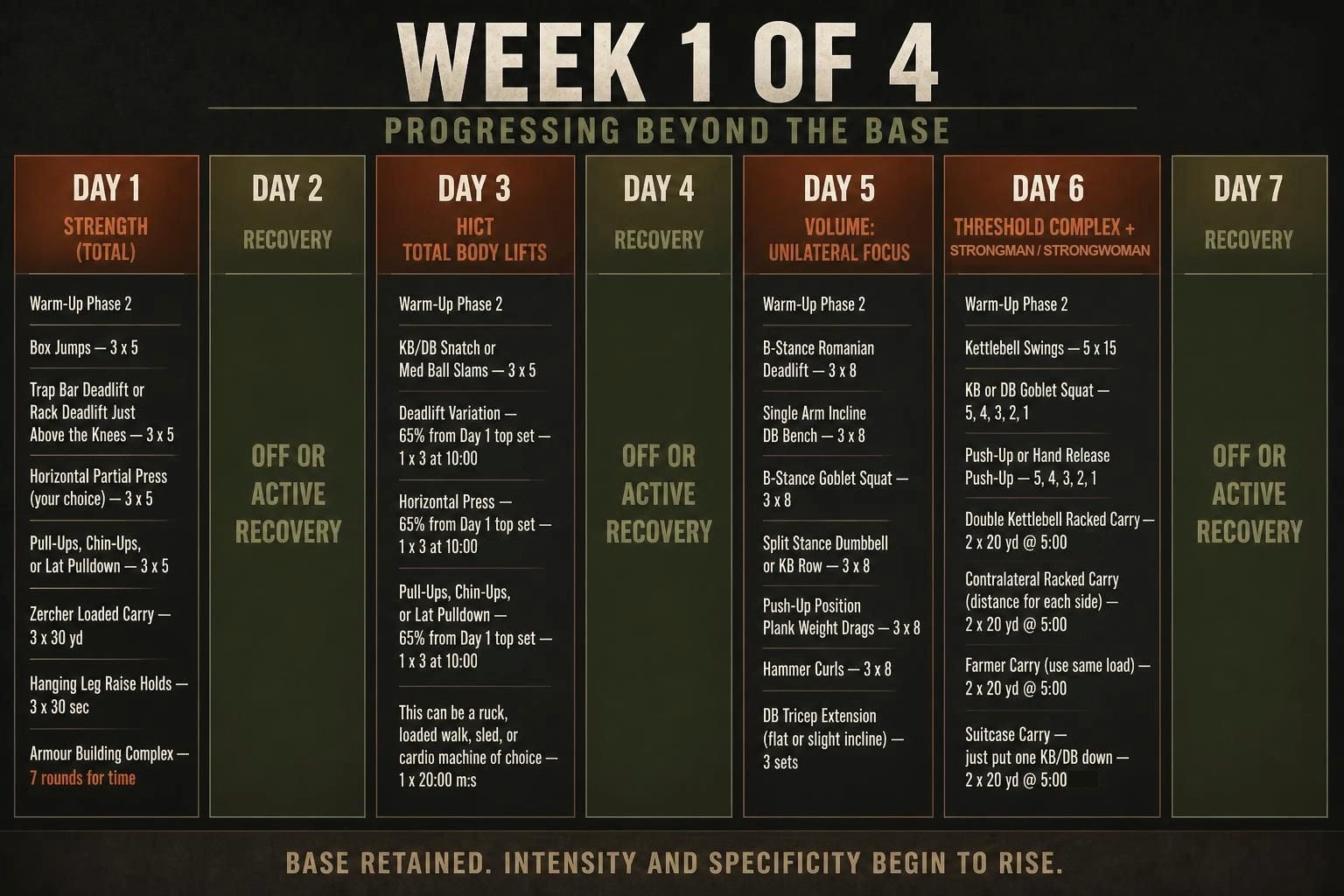
Day 1: Strength Plus Complex
Heavy sets of five followed by loaded carries and abdominal work.
For the complex, we use Dan John’s Armour Building Complex:
-
2 double-kettlebell cleans
-
1 double-kettlebell press
-
3 double-kettlebell front squats
Repeat for seven rounds. In Week 1, perform the rounds every minute on the minute (EMOM).
Why
This day is obviously strength-focused: big lifts and heavier sets of five. Without interfering with that main focus, and to add a little extra work to help maintain our aerobic conditioning, we add the complex at the end.
By performing it EMOM, the complex should take approximately seven minutes. Your heart rate should remain in an aerobic zone for the majority of the time, and you’ll perform almost all of the basic human movements. After four weeks of the foundational program, this intensity should be manageable.
Just don’t go too heavy.
Day 3: High-Intensity Continuous Training Circuit + Ruck
The focus will be big lifts with lighter weights, moved quickly, using timed sets.
Use 65% of your top set from Day 1. After your warm-up and some medicine-ball slams:
For 10 minutes:
-
Deadlift variation × 3
-
Press × 3
-
Pull-up or row × 3
Keep your heart rate around 150 bpm. If it goes over 155, slow down or stop for a bit. The idea is to complete as many sets as possible while maintaining this intensity. Let your heart and body adapt. Don’t rush this.
Then complete a 20-minute ruck or weight-vest walk. Keep your heart rate between 120 and 150 bpm.
Why
The HICT circuit trains your ability to repeat explosive efforts while fatigued. The ruck trains your ability to move under load after the fatiguing circuit while keeping you in an aerobic zone—approximately 150 bpm or below.
The duration of this session increases over the month, but even in Week 1, the entire session will amount to 30 minutes of essentially loaded aerobic work. Remember, the idea is to maintain explosive efforts. You’ll need to slow down or stop if power output drops significantly or your heart rate climbs rapidly.
Your body will learn. You will get stronger. But give it time.
Days 2, 4, and 7
These are either off days or active-recovery days.
If your schedule allows, these are great days to sneak in 20–45 minutes of low-impact Zone 2 work. Keep these sessions toward the lower end of that range and, certainly, below 150 bpm.
On days like this, the bike, light sled pulls, or even unloaded hiking are phenomenal options. These sessions should enhance your recovery, not take away from your next session. Don’t turn them into another high-intensity workout.
Why
Recovery. It is very straightforward, but your lifestyle in these professions requires off days. Add in some foam rolling while prioritizing your nutrition, hydration, and sleep, and you’ll be able to crush not only your training but also your shifts.
Note: For individuals in exceptional shape, Days 2 or 4 are good days to fit in boxing or BJJ work. I could also see adding this on Day 3 at some point if you aren’t working that day or if it fits your schedule.
Notice I said “or,” not every day. You are still going to need rest days.
Closing
Aerobic fitness is a never-ending endeavor that requires consistent discipline to maintain. What is great about it is that once you build the base, it takes longer to lose. If you take the time to maintain it as outlined above, it will stick around even as you begin working in slightly higher aerobic zones or prioritizing different conditioning methods.
Next week, we’ll discuss Day 6 and the importance of training our anaerobic threshold.
Questions? Reach out.